t’s been ten years since the introduction of Dave Wilson’s WAMM Master Chronosonic (WAMM MC) speakers. How times have changed. Many of today’s most highly regarded speaker manufacturers, as well as electronics makers, were new kids on the block ten years ago. Ten years on, speakers that dwarf the WAMM MC in size and cost have become almost commonplace. In addition, quite a few of these newer speakers have pushed the boundaries of what we expect from great speakers, making it much more crowded at the top. Back in 2016, Dave Wilson introduced his WAMM MC by word of mouth followed by visits from individual press, who came to the Wilson residence to see and hear what all the excitement was about. And without exception, the reaction was positive. Marc Mickelson posted his impressions, and Roy Gregory reported on his visit. Around the time of these visits, Dave Wilson’s son Daryl took over as CEO at Wilson Audio. Dave Wilson passed away a couple years later.
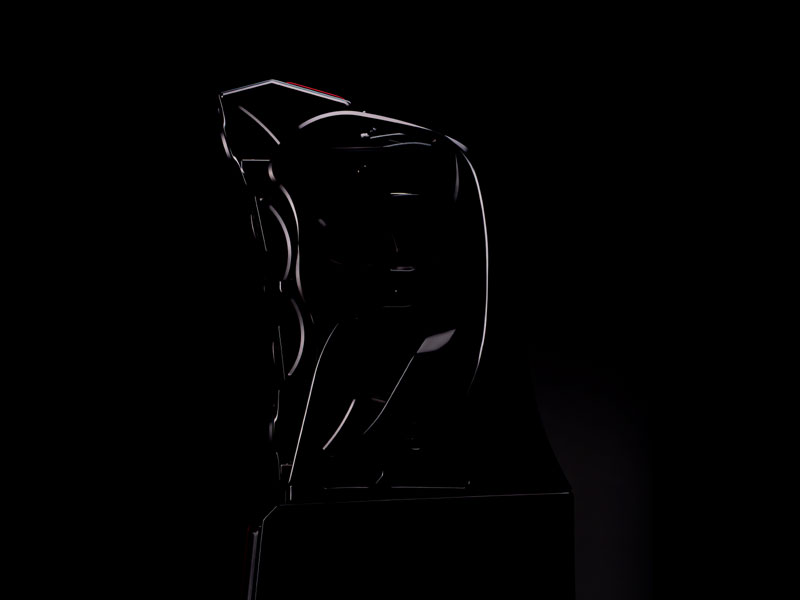
A decade on, and as with other businesses, social media has taken a larger role in rolling out new products. In advance of the official unveiling of a new super speaker, Wilson Audio posted “teaser” photos of various corners and edges of the new speaker as well as a disclosure of the new speaker's name, the Autobiography. A press event was scheduled in Provo, Utah, where Wilson Audio is headquartered, for April 22. Given the drum roll of publicity, and a photograph of a portion of an alignment sled (used to adjust speaker position and only used on the largest Wilson speakers), the Autobiography was intended to be Wilson’s new top-of-the-line speaker.
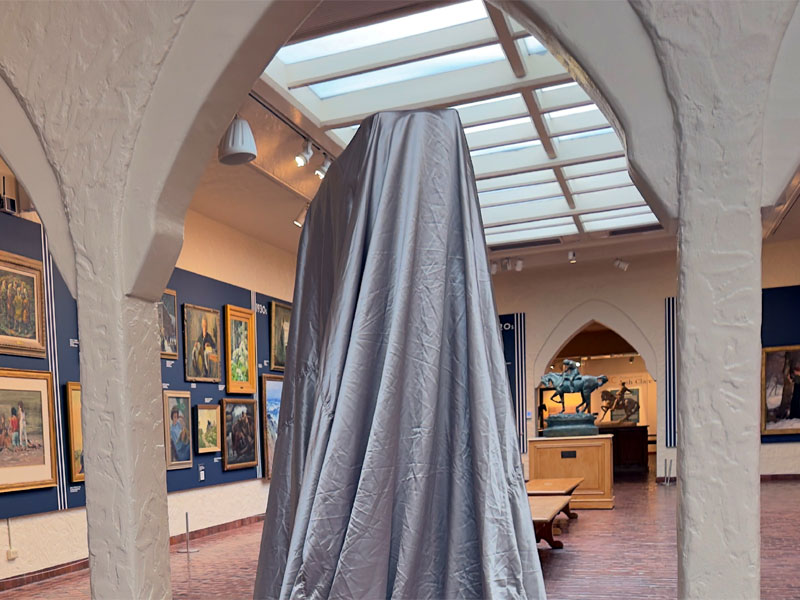
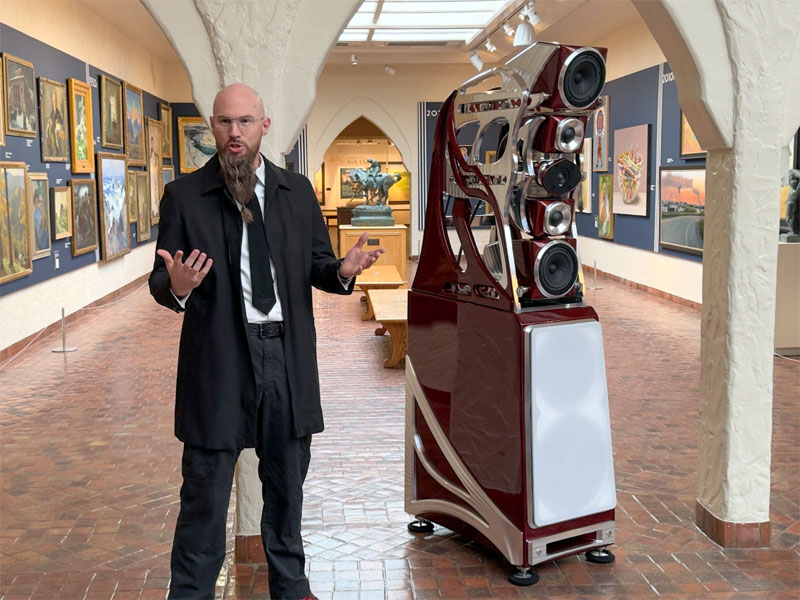
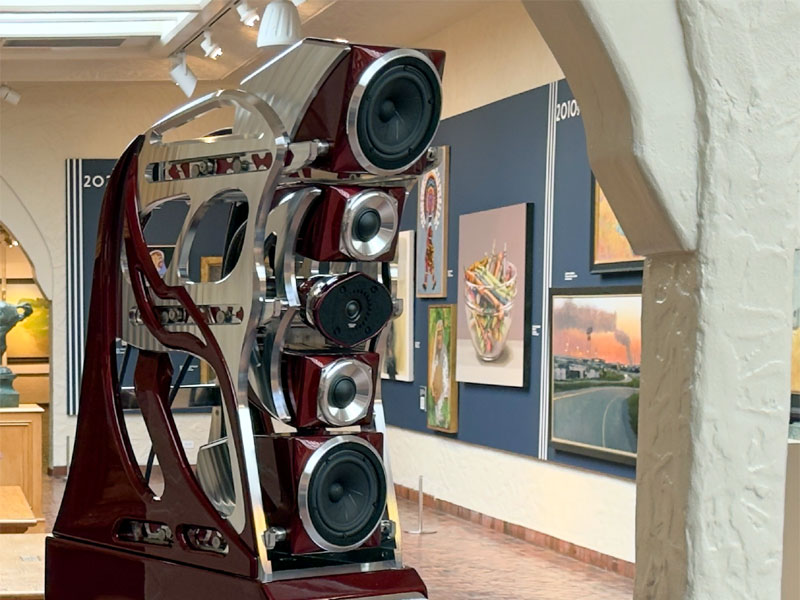
The unveiling (literally) was presented at the Museum of Art in Springville, Utah, a short distance from Wilson Audio’s factory. Daryl Wilson pulled the curtain off a single Autobiography for nine members of the audio press and delivered a flurry of statistics and development information. After that presentation, the group met at the Wilson factory and broke into two groups. Some headed to Dave and Sheryl Lee Wilson’s home to listen to the Autobiography, while the others were treated to a factory tour, after which the groups traded places.
My trip from San Francisco to Salt Lake City started on a somber note, as, on my travel day, Michael Tilson Thomas died. His 25-year tenure as conductor of the San Francisco symphony could not but give rise to a comparison to the life and achievements of Dave Wilson, who began his career in the San Francisco Bay area and made a comparable impact on the audio world. I could sense the weight of that legacy on Daryl Wilson’s shoulders as he pulled the drapery off his new creation.
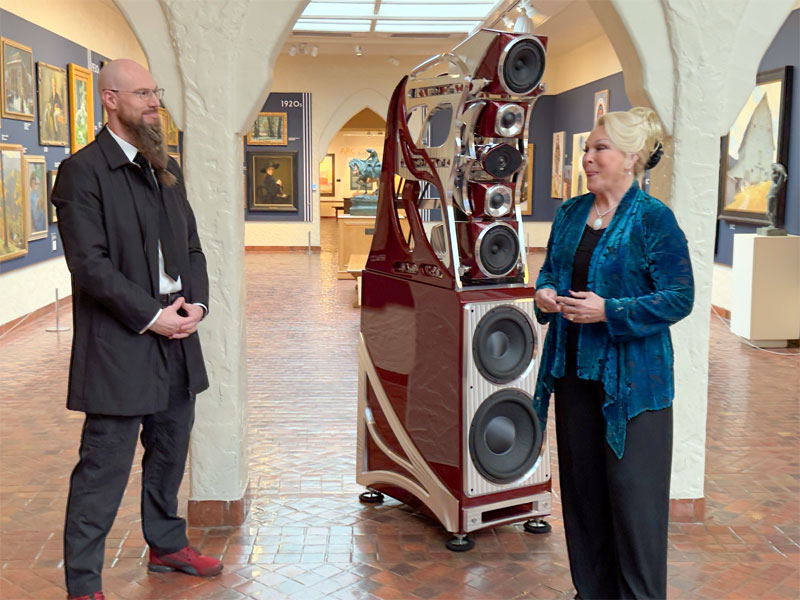
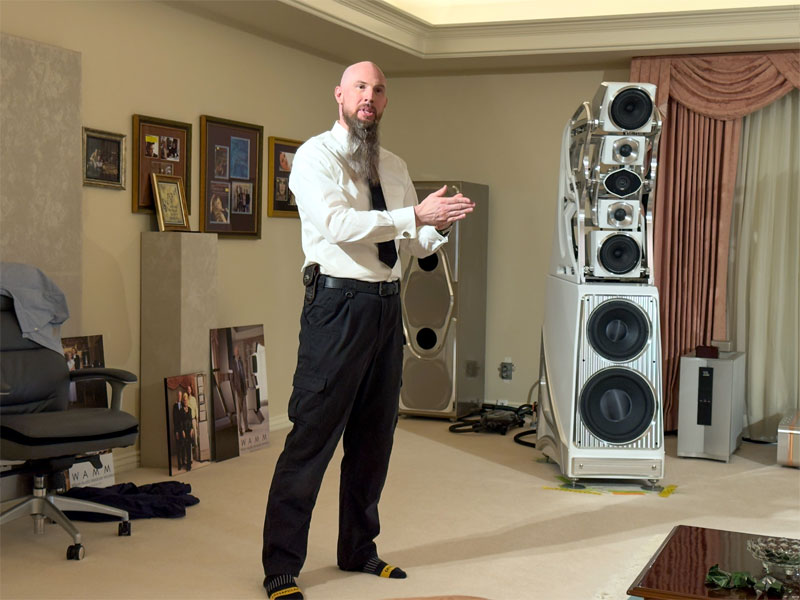
Daryl and Sheryl Lee Wilson discussing the Autobiography. Before the introduction of the new speaker, a few things were obvious. The Autobiography is not so much a downsized WAMM MC as a refined concentration of Wilson Audio's design principles. While the overall dimensions and weight are only slightly streamlined, the immediate visual impact is obvious: the WAMM MC was a champion boxer, and the Autobiography is a ballet dancer.
Much of that visual impression is down to the redesigned drivers and their enclosures. The Autobiography incorporates an entirely new complement of drivers, and it lends a new and, to these eyes, an entirely improved sense of visual balance to the speakers. First, although the footprint is slightly reduced, the new speaker boasts 15" and 12" woofers, compared to the WAMM’s 12.5" and 10.5" pair. The new midrange pairs 7" and 2" drivers, in contrast to the WAMM’s 7" and 4" drivers. It’s not just the size of the drivers, but the much more streamlined enclosures that give the overall impression of something really new. Overall, the Autobiography appears perfectly balanced. Where the WAMM MC was a bit top heavy in appearance, the Autobiography, with its larger bass drivers and minimalist upper cabinetry, is more streamlined. It did not look out of place in a modern art gallery.
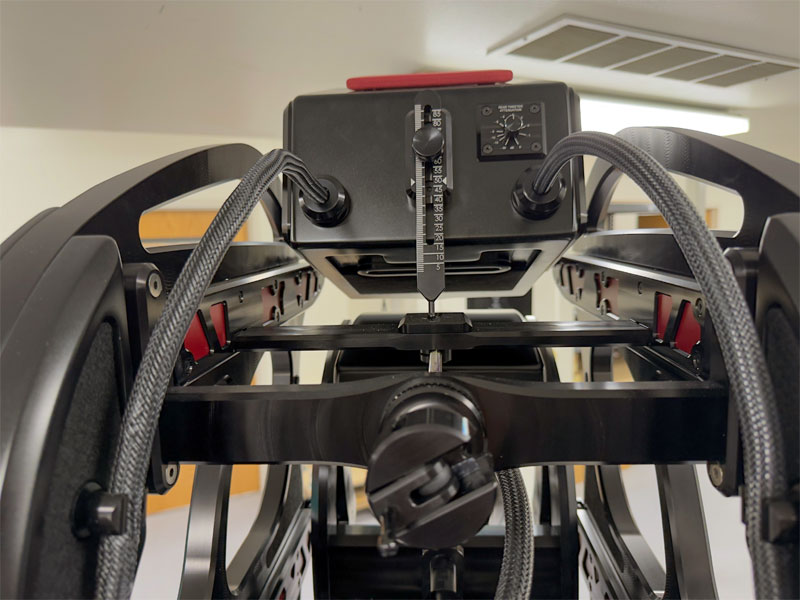
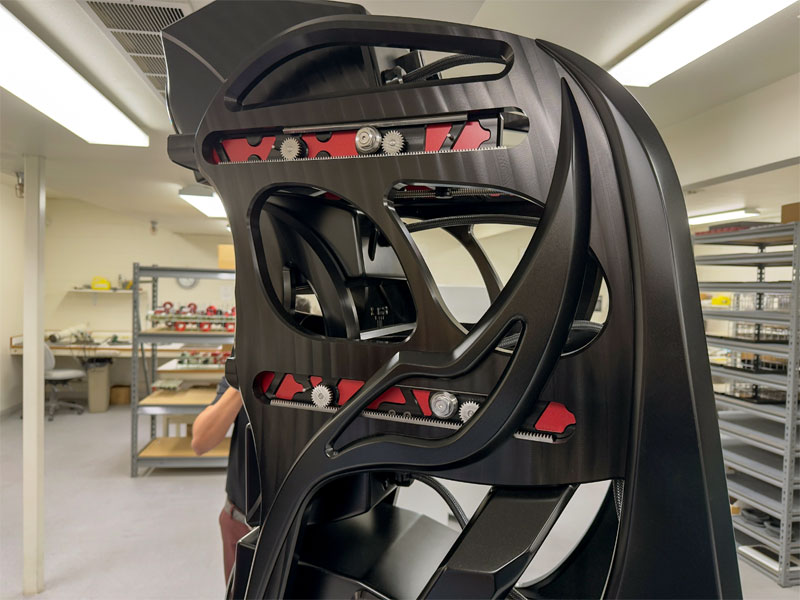
On a micro level, attention to detail is equally impressive. A significant goal of the larger Wilson speakers is time-domain adjustability -- the ability to make precise adjustments to the individual elements of the upper array of drivers within the supporting gantry structure. The slimmed-down elements of the gantry support system allow you to see the three alignment sleds -- one each for the two large midrange units and a middle sled to adjust the crescent frame cradling the forward-firing tweeter and two 2" midrange units. Three sled units allow infinite front-to-back adjustments of the upper modules. Each sled is adjusted using a rotating cam mechanism that operates very smoothly and locks everything into place when situated as desired.
Despite the similar look and construction, every component in the Autobiography is different and improved over what is used in either the WAMM MC or any other existing Wilson speaker. The WAMM MC has about 800 parts. Autobiography tops 1800, the result of a more complex time-domain system that allows for continuous adjustment and, when locked into place, a rock-solid platform. The Autobiography costs $788,000 per pair, subject to higher cost for premium colors. Compared to the introductory price, ten years ago, of $645,000 per pair for a WAMM MC, this pricing shows remarkable restraint, given what value of the dollar and the completely revamped design.
The development of the Autobiography caused Daryl Wilson significant anxiety. He thought long and hard about whether it would be disrespectful to develop a new speaker that eclipsed his father’s ultimate creation and considered aiming for something just short of the WAMM MC. But, after long consideration, his father’s spirit delivered the message: “Don’t hold back.” Daryl, who is (like his father before him) one of the nicest and most sincere members of the audio-manufacturing community, tears up when he tells this story. In fact, the new Wilson Product Guide (still in a limited print run) lists the Autobiography between the Chronosonic XVX and WAMM Master Chronosonic.
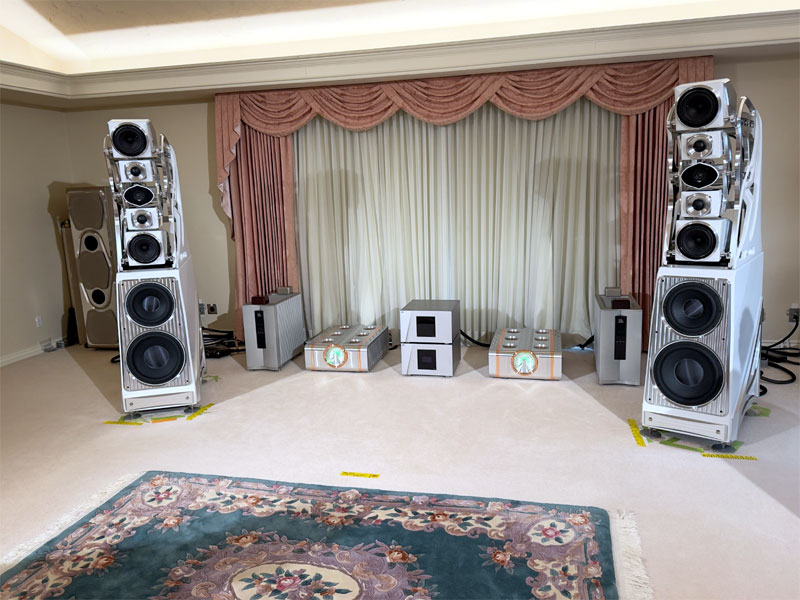
In the listening room, the Autobiography was auditioned with an impressive amount of gear. Amplifiers arrayed between the speakers were from D’Agostino, VTL, and CH Precision, but only the D’Agostino amps were in use. Preamplification was supplied by a VTL. Transparent speaker cables, various Transparent interconnects, and Shunyata power cords and power distribution were used. Vinyl was played on a TechDAS turntable with a Graham tonearm and Lyra cartridge through an Audio Research phono stage. Digital playback was streaming via Antipodes, Roon and dCS. I’ll leave out details of subwoofers and related gear because they were not used, and quite frankly didn't need to be used. The same goes for the CD player, as no CDs were played. Everyone rotated seats every couple of cuts, so that everyone had the opportunity to listen from the “Dave Wilson seat” situated in the sweet spot. One listener asked which of the amplifiers was driving the subwoofers. However, the bass of the Autobiography speakers was so perfectly balanced and deep that I imagine it would be hard to improve its performance with subwoofers and the integration issues they would introduce. One cut from audiophile super disc Bill Berry’s For Duke [Realtime Records RT 1001] was the only sample of vinyl played. A few of Peter McGrath’s recordings were played from hard disc, and the rest of the music was streamed. At the end of the scripted program, each press representative was given the iPad and allowed to pick one short piece for streaming. I’m not a fan of streaming, but I selected a piece from Víkingur Ólafsson's wonderfully performed and beautifully recorded album Debussy-Rameau. I’d recently compared the LP [DGG 483 8283], an HQCD [Universal UCCG 46093] and on as many streamed high-def versions as I could find. On the far more modest Wilson Alexia V's I own, the LP sounds outstanding, the HQCD not quite as good but still outstanding, and the streamed versions all comparatively dreadful. The Autobiography did an excellent job of reproducing all the problems that the streaming engineer baked into that version. In summary, the Autobiography did everything I could hope for in sonic terms. On the LP and Peter McGrath’s recordings that I was familiar with, the new speakers were unparalleled. I recall that what struck me as most impressive ten years
ago about the WAMM MC: its uncanny ability to re-create the correct stage size and
the precise position of the players. As Roy Gregory summed up the performance of the WAMM
MC, “Performers weren’t just the size that you expected them to be; they were in
exactly the right place too.” That birthright appears to have been passed on to the
next generation of Wilson’s top speaker, and increased along the way with
improvements in materials technology and the generational growth of Daryl Wilson’s
brilliance and natural modesty. I hope to hear more of this new super speaker. |