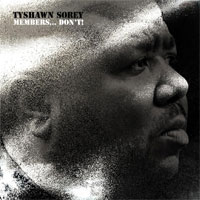
Tyshawn Sorey • Members...Don't! Pi Recordings PI112
Sorey’s Members... Don’t! was recorded live at New York’s Jazz Gallery in June 2025: a 95-minute continuous suite spread over two CDs. That’s three times longer than the compact LP, the protracted length its own statement about endurance in the field. Roach’s aggressive horns were Charles Tolliver on trumpet and altoist Gary Bartz; Tyshawn Sorey’s parallel lineup has darting trumpeter Adam O’Farrill (who treats his horn with electronics here and there for a little background fireworks) and too-little-celebrated Jamaica-born tenor saxophonist Mark Shim. Roach had Stanley Cowell on piano/electric; bassist Jymie Merritt had left his upright home to play plump punchy bass guitar. Sorey has up-and-comers Lex Korten on piano, featured at length, and bassist Tyrone Allen II, heard mostly in plumply sturdy support. The band plays the same seven pieces, but reordered to make the vocal title track the program’s emotional climax. Andy Bey had sung Roach’s gospel-tinged piece, drawing on the spiritual “Keep Your Lamps Trimmed and Burning.” Sorey taps singer-of-the-moment Fay Victor for the mutter-to-a-yowl revival, and for the revival feeling. (We note she sings “dimmed and burning.”) Shim’s tenor obbligatos get right on her wavelength, firing Victor’s impassioned phrases back at her, zeroing in on many of the same pitches. The band can slam behind her, knowing she can rise above and make her voice heard: action as metaphor. The band’s compositions were modal, broadly speaking: they improvise on chords but without traditional harmony’s goal-orientation. The new quintet runs with that open-ended, could-go-on-forever quality. Roach observed the traditional string-of-solos format. Sorey’s makeovers vary: the horns might play long serial solos, or trade short ones, or volley individual phrases, or improvise together. A melody might be buried in the middle of a 15-minute jam, and might be played tight, or in loose formation. There’s a lot of textural and rhythmic variety; it is very rarely a full-band free-for-all (until the close anyway). On “Effi” and “Abstrusions,” where trumpet improvises over piano, you’d be hard-pressed to say who’s accompanying who, so closely do O'Farrill and Korten track each other. (Shim and Korten get their mind-meld on the first part of “Equipoise.”) O’Farrill’s tone is tart, bright, light-footed; Shim’s is rougher, weighty, commanding, oddly bassoon-like at times; where the trumpeter skims over the rhythm section’s time, the tenor might tumble straight through. It’s a great combination. (The pair also play in a Patricia Brennan septet.) Pianist Korten’s solos seem the longest, and he can go on a bit, as on “Equipoise (Part Two),” but there he slips in a rare quote from David Shire’s earworm piano theme to Francis Ford Coppola’s The Conversation. Sorey is such a high-profile composer nowadays -- his other new album, companion to this one in a way, is monochromatic light (afterlife) (on DACAMERA) in homage to Morton Feldman’s spare quiet 1971 Rothko Chapel -- it’s easy to forget what a formidable jazz drummer he is. (After playing duo with him in the 2000’s, picky Dutch pianist Misha Mengelberg told me, “Tyshawn is the new Max Roach.”) Some great drummers have a ride-cymbal beat so compelling they can’t get away from it. Sorey’s is lighter and crisper, played closer to the cymbal’s hub, so the bottom doesn’t fall out of the group sound when he moves away from it. He can play at the threshold of hearing, thwack out a back-beat or swing with heavy authority (the last two on “Libra”). His comping is involved and interactive but never deafening -- like a quieter Ralph Peterson. The live sound is clear and uncongested; only
occasionally can you hear audience members screaming approval. Gift Pratoomvieng did the
remote recording, mixed and mastered by David Darlington. (Congratulatory applause edited
out, thank you.) There’s a little hocus-pocus at the end of disc one, midway through
“Equipoise”: the last three minutes of Part One is a loop of a piano lick (with
accompaniment) that introduces the next section of the tune on disc two. So: you hear the
loop before the sample. As if to say: When you feel yourself going in circles, take a
little break, then you can proceed. Or maybe I’m reading too much into that. |



 few classic
jazz albums have gotten modern makeovers, a trend that got moving in the teens with Terri
Lyne Carrington’s stylized remake of the Duke Ellington/Charles Mingus/Max Roach
trio’s Money Jungle. More recently she (and singer Christie Dashiell) issued
We Insist 2025!, rebooting Roach’s 1960 Civil Rights statement all too sadly
relevant to our own time. Now comes Tyshawn Sorey’s stretched out remake of
Roach’s Members, Don’t Git Weary, recorded after the assassinations of
Malcolm X and Martin Luther King: Roach’s rueful reminder that the battle is ongoing
and you’ve got to stay in it. (Roach, Carrington, Sorey: all drummers, who know about
making instrumental music talk.)
few classic
jazz albums have gotten modern makeovers, a trend that got moving in the teens with Terri
Lyne Carrington’s stylized remake of the Duke Ellington/Charles Mingus/Max Roach
trio’s Money Jungle. More recently she (and singer Christie Dashiell) issued
We Insist 2025!, rebooting Roach’s 1960 Civil Rights statement all too sadly
relevant to our own time. Now comes Tyshawn Sorey’s stretched out remake of
Roach’s Members, Don’t Git Weary, recorded after the assassinations of
Malcolm X and Martin Luther King: Roach’s rueful reminder that the battle is ongoing
and you’ve got to stay in it. (Roach, Carrington, Sorey: all drummers, who know about
making instrumental music talk.)