Thelonious Monk Quartet • Monk in Tokyo Sony/Speakers Corner SOPW 69/70
Starting in the mid-1950s, American jazz musicians began touring various parts of the world, often playing with local ensembles, sometimes formed just for them. Here, however, we have Monk's quartet just as jazz lovers would want it: Charlie Rouse on tenor sax, Butch Warren on bass, and Frankie Dunlop on drums. Sonny Rollins was famous for not wanting a pianist or guitarist in his ensemble, thinking that it would limit his own musical possibilities. Monk was just the opposite. Rouse was a distinct voice, and Monk used him almost as a foil, often playing off him and his solos. In 1963, Monk was in his prime, and his playing in Tokyo was rife with rhythmic invention. He could keep odd time and play melody at once, often taking a tune in exciting new directions. Here we get versions of Monk originals “Straight, No Chaser,” “Panonica,” “Blue Monk,” and “Bemsha Swing.” An absolutely crack, nearly eight-minute version of his lesser-known composition “Evidence” opens side two. It's always enlightening to hear what Monk does with well-known tunes -- there's a solo version of “Just a Gigolo,” and later the quartet's “I'm Gettin' Sentimental Over You.” The playing is solid and often adventurous. Monk always gravitated toward the latter; he was a natural innovator, not a pianist to settle into a melodic rut. There are fine solos by the band members, but it's Monk's halting, fractured rhythms that push each number forward. The audience applauds enthusiastically after each number, perhaps as a sign that they are hearing the Monk they wanted and expected. Every Speakers Corner pressing I have heard has been exceptional -- free of sonic artifacts and quiet to the very bottom of the groove. As with all of the others, Pallas pressed Monk in Tokyo, and I can't recall that I heard even one tick or pop during multiple listens. While there is no indication of who did the remastering and the cutting of the lacquers, Speakers Corner is deeply committed to the quality of its pressings, and they've created a separate website to explain the particulars. The sound is meaty and vivid, with crackling transients and a perspective from the first six rows, not the balcony. Monk is in the left channel, with sax and bass in the middle, and drums on the right. There are some slight shifts in Rouse's position, signs he's walking the stage or turning his horn as he's playing. I'll go out on a limb and say that Monk in Tokyo is among the two or three best-sounding Monk recordings, which makes its odd release history all the more confusing. Along with Monk's Prestige titles and the best of the
Columbia recordings, Monk in Tokyo is worth adding to your collection for its
music, history and exceptional sound. After hearing Monk in Tokyo for the first
time, I immediately blurted out “Where has this album been?” Hiding in something
close to plain sight, it turns out. |



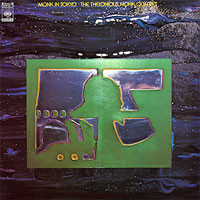 t's an unusual occurrence when I've never
seen or heard of a particular album from a major jazz figure, but that was the case with Monk
in Tokyo. As its title implies, it features Thelonious Monk and others in concert at
Sankei Hall in Tokyo. Columbia Records initially released it as two separate LPs -- In
Tokyo 1 and In Tokyo 2 -- in 1963. They then re-released it as a shortened
single CBS/Sony LP in 1969. In 1973, it was finally available as a double LP, the form it
is here. It captures Monk's quartet on its first Asian tour, performing several of his
compositions interspersed with a pair of jazz standards.
t's an unusual occurrence when I've never
seen or heard of a particular album from a major jazz figure, but that was the case with Monk
in Tokyo. As its title implies, it features Thelonious Monk and others in concert at
Sankei Hall in Tokyo. Columbia Records initially released it as two separate LPs -- In
Tokyo 1 and In Tokyo 2 -- in 1963. They then re-released it as a shortened
single CBS/Sony LP in 1969. In 1973, it was finally available as a double LP, the form it
is here. It captures Monk's quartet on its first Asian tour, performing several of his
compositions interspersed with a pair of jazz standards.