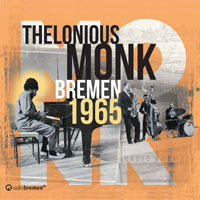
Thelonious Monk • Bremen 1965
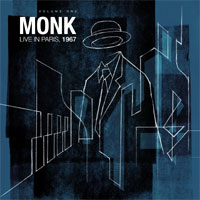
Thelonious Monk • Monk Live in Paris, 1967 - Volume One
f you've ever wondered how someone can identify a single jazz musician from an ensemble of four or five, go listen to any Thelonious Monk record. His musical voice is as distinctive as a lion's roar. Monk was all about defying rhythmic and harmonic expectations; a tune will not be so deconstructed that it doesn't sound like itself, but the way it's played, with Monk's twisting, start-stop fingerprint, is unique and immediately recognizable. As jazz careened from one aesthetic style to another, Monk remained true to himself and a connection to the music's avant-garde. His idiosyncratic rhythm and timing are singular in jazz history, and when modern pianists try to mimic even a minor element of his technique, their playing often sounds contrived. Jazz notables toured various parts of the world beginning in the mid-1950s and throughout the 1960s; among them, Monk was a headliner of the first rank. Earlier this year, I reviewed a label-released live recording from this time, Monk in Tokyo, which proves he was a draw in Asia. These two new recordings are from European performances captured during that same time, after Monk changed labels, moving from Prestige to Columbia. One comes from Rhythm-A-Ning Entertainment, the label of the Thelonious Monk Estate, with involvement from Monk's grandson and great-grandson. The other is a collaboration between Rhythm-A-Ning Entertainment and Sunnyside Records, an independent jazz label with a straightforward credo -- “We simply release music that we like” -- and a large catalogue of recordings and roster of affiliated labels. The tapes for the Bremen performance come from Radio Bremen, which recorded Monk's quartet in its Sendesaal / Studio F in front of an audience. The quartet had been in transition following Monk's move to Columbia. The lineup in Bremen -- Charlie Rouse on tenor sax, Larry Gales on bass, and Ben Riley on drums -- didn't record together in the studio until late in 1965. An eleven-minute version of “Criss Cross,” with its buoyant recurring piano phrase, begins the concert. What follows is a stream of Monk originals, including long versions of “Well You Needn't,” “Epistrophy,” and “Rhythm-A-Ning,” interspersed with covers Monk recorded on one or more of his studio albums, including “Just You, Just Me” and “I'm Getting Sentimental Over You.” While the audience probably wanted to hear the originals -- Monk was one of jazz's greatest composers -- the covers are fascinating. They feature extended solos by all of the quartet's members. During these breaks Monk often stood up from the piano, walked around the stage, and even danced. Many of the cuts are over ten minutes long, but the highlight for me is the five-minute solo version of “Don't Blame Me.” It's played with great restraint, its hesitations and pauses drawing out the emotion. It's achingly beautiful. Monk Live in Paris, 1967 - Volume One is not to be confused with Monk in Paris: Live at the Olympia, another informal concert recording. While the Paris quartet is the same as in Bremen, Paris, 1967 - Volume One could easily be billed as the Monk Quartet “with friends,” because there is a host of guests -- Phil Woods on alto sax, Jimmy Cleveland on trombone, Ray Copeland on trumpet, and Johnny Griffin (who preceded Rouse in the quartet) on tenor sax. After introductions, “Epistrophy” begins, with solos from Griffin and Copeland. Three more Monk originals follow: “Evidence,” “Ruby, My Dear” and “We See.” Monk was not a leader who felt constrained by other strong voices; the four guest horns are prominent on all numbers except “We See,” which has the quartet alone. Monk and Rouse provide sparkling support and solo playing throughout, with Gales and Riley providing firm rhythmic backing. My only complaint of this LP is the mere four cuts, but the second volume is due in October. It will add Clark Terry to Monk's quartet and friends. Both of these releases feature quiet 180-gram pressings, though there is no indication of where the lacquers were cut or the LPs were pressed. While the sound of live recordings, especially ones that were not meant to be released, can vary greatly, here it's detailed and redolent with fine details across both concerts, including a palpable sense of the recording venues' space. Bremen 1965 includes a broadside insert filled with useful information on the recording, including this on Monk's dress for the concert: “a green suit with pink tie along with a fur hat and bright yellow shoes,” a tidbit that brings the insert's black-and-white photos to life. Live in Paris, 1967 is billed as “the first in a new series of previously unreleased, rare live recordings, mastered by Rudy Van Gelder,” but how that was accomplished is not discussed. I would be interested in the details -- Van Gelder died in 2016. Through Rhythm-A-Ning Entertainment, the Monk estate is
planning “a new ongoing series of archival recordings under its authorized control of
material that has been circulated for years as bootlegs” -- exciting news for
lovers of classic jazz. These two live recordings are not the place to begin a Monk
library -- I suggest Thelonious Monk Plays Duke Ellington, to hear what the
master does with classic compositions that are not his own -- but they are worthy
additions to any collection of twentieth-century jazz. |