The Who • Who's Next
Analogue Productions UHQRs are greater in number than those earlier releases, each pressed on clear Clarity V2 vinyl. Lacquers are etched at a lower-than-standard voltage in order to produce finer-grained stampers. Stringent stamping, plating, and quality-control techniques are employed, further driving up the cost of production. The UHQRs are packaged in a hard box enclosing a facsimile of the original sleeve along with commissioned liner notes and photographs. In addition to being one of the greatest rock recordings ever produced, Who’s Next ranks as one of the best-sounding examples of classic rock. Much of that is due to engineer Glyn Johns, who recorded and mixed all but one of the songs at Olympic Studios in London. Johns was one of the giants of the industry. He was responsible for more than a dozen Rolling Stones albums and a few late masterpieces from the Beatles. Throw in some Led Zeppelin, Eric Clapton, Neil Young, and the Who albums and you are only scratching the surface of his impressive discography. Similarly, Olympic Studios was one of the dominant recording studios of the twentieth century, eclipsed in reputation only by Abbey Road. I give the edge to Olympic Studios when it comes to sound quality. As a result, Who’s Next sounds great over a wide variety of pressings. In addition to an incandescent performance, the sound quality of the album is among the absolute best of the era. In addition to decent bass, great dynamic, and clean, undistorted guitars, the album presents a large soundstage that makes you feel like you can walk in and become part of the band, your mouth agape at the wonders of the performance. You can also turn up the volume way past what you may consider advisable on whatever system you are using -- it takes a lot of volume to drive the record into distortion downstream. These attributes are best appreciated on a high-quality sound system. Yet, if you go online you can find numerous comparisons among various pressings, where the examples are digitized and presented in a video intended to be appreciated on a desktop system or, even worse, a portable device. The two most important things I listen for in a comparison of Who’s Next versions are timing and transparency. There are also differences in dynamics and deep bass, but the two T's make or break this record. And as wildly popular as YouTube comparisons have become, an evaluation of the transparency and timing of a digitized recording reproduced on a computer is simply not meaningful. Over the years, many versions of Who’s Next have come into my collection; most have gone, but the finest have remained, waiting for an eventual thinning of the herd. Certain pressings have risen to the top of the heap. For this review, I compared the main contenders to the new UHQR: MCA's Heavy Vinyl version from a few years ago [MCA 11164], the Classic Records Quiex version [MCA/Classic Records DL 79182], and a Track original pressing [Track Deluxe 2408 102]. My sound system has improved since I acquired each reissue, but the comparable values of the various pressings remain unchanged. The MCA Heavy Vinyl reissue still sounds as uninvolving as it did to me three decades ago. I'll put that in perspective. First, back then, heavyweight vinyl was a relatively new thing. Second, Kevin Gray was at a comparatively early stage of his career. Gray’s mastering chain has changed for the better a few times since then, and his skill has only increased with the years. Third, it sounds like the overall EQ was adjusted for the worse, creating an odd-sounding tonal balance. To me, this pressing also lacks transparency and clarity. Compared to the Track pressing and even some early Decca pressings, it is simply dull and uninspiring. The Classic Records Quiex version was a revelation after the disappointing MCA Heavy Vinyl version. Classic Records used Bernie Grundman for mastering and RTI for pressing its vinyl. Although it initially impresses with its bass, dynamics and “you are thereness,” it shares the all-too-common Classic Records flaw of slightly harsh upper registers. And like the Heavy Vinyl version, it lacks the transparency and inner detail that the best pressings confirm were baked into the master tapes. Does the Glyn Johns magic shine through this new Analogue Productions reissue better than with the Classic Records version? Yes, and by a wide margin. Gone is the Classic Records sound that often marred its reissues. The UHQR is simply better in almost every way -- more detail, less stridency, better bass, and a deadly quiet background. How does it stack up against an early Track original? Here it is a much closer contest and depends on what you are listening for. Are timing, delicacy, transparency, and detail most important to you? Or do you crave extended bass guitar and kick-ass Keith Moon drums? The UHQR kicks butt in the lower registers. On “Won’t Get Fooled Again,” the strengths of the UHQR version are immediately obvious. The UHQR reproduces Moon’s percussion show and Entwistle’s bass guitar with a sense of energy and dynamics not reproduced on any original or reissue. Those remarkable dynamics are aided in no small part by the dead-quiet background. The best copies of the Track original pressing excel in timing and delicacy in ways that set it apart from the pack. Compare the Track version of “Baba O’Riley” to any other version and you can feel that no other version is quite in sync. Nothing else captures the fast-moving delicacy the same way as the Track pressing. There are intricate details that just do not reveal themselves in any other version. But, to be fair, these parts of the recording are spare and largely overwhelmed by the more muscular parts of the music, where the UHQR excels. The UHQR is a close second when it comes to the more delicate parts of the music but a clear winner when it comes to the bigger moments, and on balance those bigger moments are what's best about Who’s Next. While the Analogue Productions price of $125, plus tax
and shipping, for the UHQR may seem high, I would wager that the cost of a near-mint Track
original now exceeds that amount. Of course, once the 7500 copies of the UHQR are gone,
resellers will be pitching them for twice the original price. I plan to finally thin out
my Who’s Next collection: I will keep my Track original along with this
outstanding UHQR. |



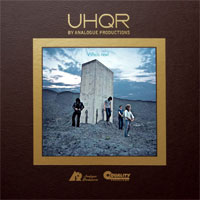 nalogue
Productions’ announcement of its release of four titles from the Who hit with almost
as much impact as if they had announced new remasterings of albums from the Beatles, David
Bowie, or the Rolling Stones. The four Who titles include Who’s Next and Tommy
as UHQRs, and Live At Leeds and My Generation as 45rpm double-disc sets.
JVC developed the UHQR, which stands for Ultra High Quality Record, in 1980 to push the
limits of vinyl pressing. UHQRs used JVC's Super Vinyl formula to produce 200-gram
flat-profile LPs. Mobile Fidelity released eight UHQRs in the early 1980s, and there
were also UHQRs around that time from Telarc, Mark Levinson, and Reference Recordings.
