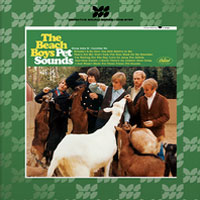
The Beach Boys • Pet Sounds Capitol Records/Interscope Records DSS 6
My goal here is not to address or redress any of the existing coverage; instead, I'll take the easiest path possible and simply tell you what I hear from this version of the album, in isolation and in comparison to a few other pressings. This Pet Sounds is part of Interscope's Definitive Sound Series (DSS) -- One Step releases that are special in every important way: remastering, pressing, and packaging. In the One Step process, the first metal part produced from the plating of the lacquer is used to press the records, reducing the overall process by two steps and putting the records two steps closer to the master tape. It also means that fewer copies of each record will be produced -- 6000 for Pet Sounds, each pressed at RTI. The vinyl is Neotech’s VR900-D2 “super vinyl,” which allows for greater groove detail. It is also incredibly quiet, so the music isn't obscured by vinyl-induced noise. Chris Bellman at Bernie Grundman Mastering created the Pet Sounds lacquers from the best tape available, so the release is all analog from beginning to end. Finally, the packaging from GPA Global is a handsome slipcase that holds the LP in its heavyweight gatefold sleeve. So with this release, Pet Sounds has received the full-on, best-at-this-moment audiophile treatment. I listened to it with both stereo and mono cartridges, on different turntables: Grand Prix Audio Parabolica with Kuzma 4Point tonearm and Dynavactor DV 20X2A-L cartridge for stereo, and TW-Acustic Raven AC with Graham Phantom II Supreme tonearm and Dynavector XV-1S Mono cartridge for mono. For comparison, I had three earlier releases: the famous Brother Records/Reprise two-fer with Carl and the Passions [Warner Bros. 2MS 2083], the 1999 180-gram “true stereo” release [Capitol Records 72435-21241-1-4], and the 1966 Duophonic faux-stereo release [Capitol Records DT 2458].
Two of these three LPs are in stereo, while the Brother Records version is in mono, like the DSS One Step. The 1966 Duophonic LP will sound pretty dreadful, unless you are a fan of the earliest stereo recordings, in which there are two discrete channels with nothing happening in between. The vocals almost sound out of phase, they are so indistinct and removed from the fabric of the music. I wrote “gimmicky” and “awful” in my notes to describe what I was hearing. The 1999 stereo version sounds good, with a real soundstage, meaty bass and good delineation of musical lines. The Brother Records mono version increases the delineation, presenting the music in a layered fashion that sounds more authentic, echoed by the blurb on LP's labels: “This recording is pressed in monophonic sound, the way Brian cut it.” The DSS One Step takes the music another few steps forward, displaying qualities that distinguish it. These includes supreme retrieval of musical detail and a realistic tonal balance, which translate to a sense of transparency to the source that is truly enlightening. The vocals float within instead of being swallowed by the rest of instrumentation, and the bass line is more apparent, increasing the music's rhythmic underpinning. It is as though I can hear every mixing choice and splice of the tape. There is a sense of directness and immediacy that's startling at first, even before you realize that the recording itself has obvious limits. All of what I describe is even more apparent with a mono cartridge, but it's there with the stereo as well. If you have the 1999 stereo mix, you have a good-sounding
version. I would probably be happy enough with it to ignore finding a 1966 mono pressing
or the Brother Records reissue, which are pricey. However, I would definitely add the DSS
One Step -- it's simply the best-sounding version I've heard, by a wide margin, and
hearing the mono mix in its full glory is a very different experience from the stereo.
Interscope is sold out on its website, but the label announced shortly after Pet
Sounds was released that it has made its DSS reissues available for sale at
brick-and-mortar record stores. Many of these stores sell online and have copies available
at the list price, not the inflated prices you'll see on eBay. So if this music is
important to you, your choice is clear: buy now or pay more later. |



 eing near the end
of the line to write about a new LP isn't often an advantage, but this new version of Pet
Sounds is a notable exception. Since its release a few months ago, it has gotten
profuse coverage, some creating controversy and consternation, as often happens on the
Internet. Pet Sounds is an album with a complicated history, having been released
in mono, rechanneled stereo, true stereo, and multichannel mixes on vinyl and various
digital discs. There are literally hundreds of versions. It's also an important album in
the history of popular music, because it introduced a novel idea: the recording studio can
be a tool in the creation of the music.
eing near the end
of the line to write about a new LP isn't often an advantage, but this new version of Pet
Sounds is a notable exception. Since its release a few months ago, it has gotten
profuse coverage, some creating controversy and consternation, as often happens on the
Internet. Pet Sounds is an album with a complicated history, having been released
in mono, rechanneled stereo, true stereo, and multichannel mixes on vinyl and various
digital discs. There are literally hundreds of versions. It's also an important album in
the history of popular music, because it introduced a novel idea: the recording studio can
be a tool in the creation of the music.