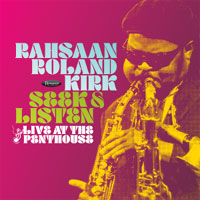
Rahsaan Roland Kirk • Seek & Listen: Live at the Penthouse Resonance Records HLP-9080
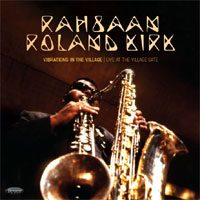
Rahsaan Roland Kirk • Vibrations at the Village: Live at the Village Gate
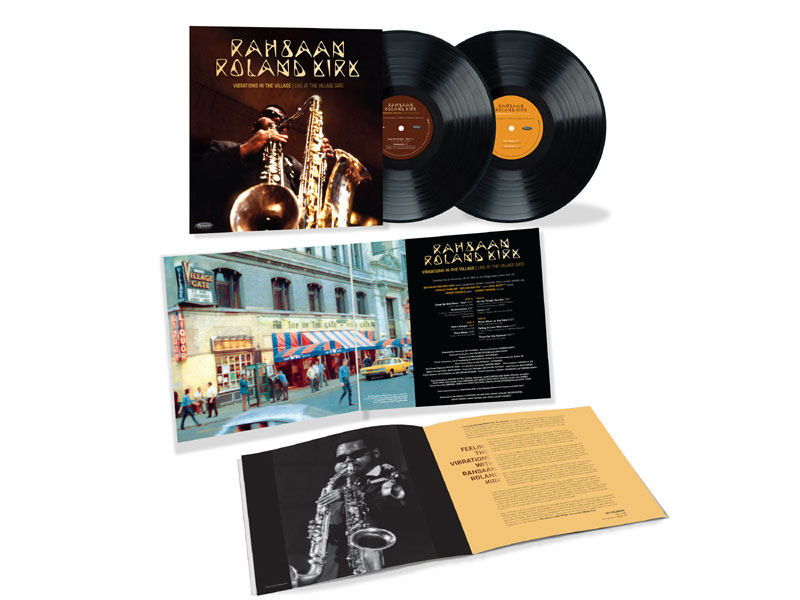
ulti-instrumentalists are rare among working jazz musicians -- playing a single instrument at a professional level is hard enough -- but there are some notable examples. While John Coltrane's first instrument was tenor sax, he also played clarinet. A more extreme example -- in terms of the instruments -- is drummer Jack DeJohnette, who was also a very good pianist. Of course, he often played with a true keyboard giant, Keith Jarrett, so he spent almost his entire career on the drummer's stool and not the piano bench. Rahsaan Roland Kirk was a different kind of multi-instrumentalist. He could not only play more than one instrument, he could play them at the same time. The cover shots for these two LP collections show Kirk blowing multiple horns at once, and there are many other photos showing him with various horns hanging from around his neck. In addition to all manner of saxes, Kirk played clarinet, English horn, piccolo, flute, harmonica, stritch, manzello, and reed trumpet. He also played instruments of his own design: a trumpet with a sax mouthpiece he called the “trumpophone,” and a small trombone or slide trumpet, also with a sax mouthpiece, called the “slideophone." Kirk, who lost his sight as an infant, was a musical savant, and he became one of jazz's most individual performers. After a stroke in 1975, he lost use of one side of his body, but he modified his instruments so he could play with the other side, until he died in 1977. These two LP collections come from concerts in the 1960s, when Kirk was in his prime and recording regularly for Atlantic and Verve, among other labels. The Village Gate opened in 1958 and was a fixture in Greenwich Village until it closed in 1994. It hosted comedians, blues musicians, and rock bands, but it is best known as a jazz club -- just about every well-known jazz musician played there. In 1963, a filmmaker hired recording engineer Ivan Berger to capture Kirk and his ensemble performing live at the Village Gate over the course of two nights. The director died, his film was never finished, and Berger's tapes sat unused for over 60 years. Then Berger contacted audiophile-speaker designer Jeff Joseph, saying, “I have these tapes. What am I supposed to do with them?” Joseph reached out to “Jazz Detective” Zev Feldman and offered him the tapes for release. “Jump Up and Down - Fast” opens the collection with a bang, as Kirk alternates dissonant blats and athletic runs with drawn-out phrases, each on various horns. It's a cut that makes me wish for the movie that never was, just to see how he was able to pull it all off. He plays Charlie Mingus’s “Ecclusiastics” with dreamy charm, breaking into sung/spoken vocals at two points. Over the 76 minutes of music, the rest of the band -- bassist Henry Grimes, drummer Sonny Brown, and pianists Horace Parlan, Melvin Rhyne, and Jane Getz -- seems to know to stay out of the way. They don't so much as musically interact with Kirk as lay down the supporting notes for him to play off and run with.
Seattle's Penthouse Club was open for just six years, from 1962 to 1968. Some of the Penthouse's performances were aired live on Seattle's KING-FM. Local radio host and broadcast engineer Jim Wilkes recorded the performances, and the owners of the Penthouse Club have made the recordings available for release. Seek & Listen, from 1967, is one of several collections from this archive, which also includes sets from Ahmad Jamal, Cannonball Adderley, Wes Montgomery with the Wynton Kelly Trio, and other jazz notables. Backed by drummer Jimmy Hopps, pianist Rahn Burton, and bassist Steve Novosel, Kirk plays plenty of adventurous music. “Alfie” is a tenor-sax staple -- both Coltrane and Sonny Rollins recorded well-known versions. Here, Kirk plays it sensitively, until near the end, when he holds a single note for several seconds and then veers to an abrupt stop. “Satin Doll” is nearly fifteen smoking minutes long, during which Kirk sounds like an entire horn section -- which, in fact, he was. These two releases increase Zev Feldman's voluminous output of recordings of previously unknown concerts on Resonance Records and other labels, often for Record Store Day or its Black Friday event, from which these recordings come. Matthew Lutthans did restoration and mastering at the Mastering Lab, and Le Vinylist in Quebec, Canada, pressed the 180-gram LPs, 1200 sets of each title. The sound of both is textured and spacious, making up for a lack of low-end impact with solid imaging and finely wrought atmosphere. There are, what sound like, a couple of tape issues that couldn't be overcome, but the whole of the music far outweighs their effect. Both collections include full-color large-format booklets with biographical information on Kirk and reminiscences from musicians who played with him. The music here follows no set style, mixing elements of
bop, hard bop, swing, soul, spiritual jazz, and even New Orleans-like big band. Kirk's
playing mirrors this diversity. He's often spectacular -- as exciting as anyone in the
history of jazz -- but he sometimes breaks his own stride, lapsing into quick, easily
recognizable phrases. Even so, the music on these two collections is modern jazz through
and through, with invention and beauty around every twist and turn. |