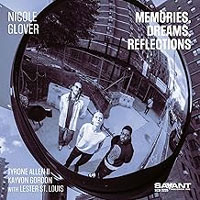
Nicole Glover • Memories, Dreams, Reflections Savant SCD 2225
In Artemis and LCJO, Glover plays with distinguished vets; here she's with younger peers Allen and drummer Kayvon Gordon, holdovers from her previous disc Play: an often but not always rambunctious working band. Her shapely ballad “Petrichor” (that’s the loamy smell of fresh rain on dry earth) has a strong melodic contour a soloist can bend all kinds of ways. Her partners give her all the space she requires, instead of filling all the gaps -- in the post-AACM (post-ECM) musical period, open space carries its own weight. There are other bendable, variation-friendly melodies here, by peer composers outside the band: “Resilience” (by Glenn Tucker), “Broken” (Lex Korten) -- and “No. 2” (Lawrence Williams) where the rhythm section is heard to advantage. At the top, Allen walks a nimble line, and Gordon, using brushes, plays lively snare and tom fills whenever Glover pauses for a breath, percussive obbligatos. Then the drummer switches to sticks, upping the cabin pressure now that they’re all airborne. They collectively raise the energy level, breathing together. Before it’s over bass and drums get their own episode -- an accompanied bass solo. “Resilience” escalates in a similar way. There are also recent tunes by trumpeter Davy Lazar and bandleader Miki Yamanaka, plus Charlie Parker’s “Bird Feathers” whose boppish accents are served straight while she avoids Bird’s phrasing (I’m sensing a pattern), and a 1955 Betty Carter deep track, the slow and somber “Tell Him I Said Hello.” Here tenor is most plaintive and fully exposed, and murmuring bass and drums never talk over her or get in the way. And finally there are two quartet tracks -- “Oblivion,” the Davis/Grimes tribute -- where cellist Lester St. Louis bows along with Tyrone Allen. Maureen Sickler recorded the band at her home base, Van
Gelder studios across the Hudson from Manhattan; Katsuhiko Naito did the mixing and
mastering; the trio members co-produced. Bass volume is realistically not overloud, reverb
is judiciously applied, there are no sonic distractions. Everything’s in balance,
behind the mics as well as out front. Nicole Glover had called her first album First
Album. She could have called this, her fourth, Fully Arrived. |



 enor
saxophonist Nicole Glover is having a moment. Work with the co-op Artemis and the Lincoln
Center Jazz Orchestra (LCJO) confirm her mainstream chops, but this trio date has a
broader reach, beyond (say) LCJO’s conservative mission. She salutes two late
outward-bound bassists with “II for Richard Davis and Henry Grimes,” and
there’s a quick fade-in/fade-out romp on a tricky vamp/melody by another bass
maverick, Jaribu Shahid from the Detroit art ensemble Griot Galaxy. On the second half of
“Obsidian” by trio bassist Tyrone Allen II, Glover echoes Albert Ayler’s
exhortatory calls-to-arms melodies but not his quavery snake-handler tenor sound. At speed
she steps lightly -- she’s a Mark Turner modern, if you will, without sounding like
him either. Like many tenor-bass-drums trios, this one’s informed by how Sonny
Rollins would pace himself and his trio mates, but there are no calypso-beat Rollins shout
outs. One can draw on such role models without sounding like them.
enor
saxophonist Nicole Glover is having a moment. Work with the co-op Artemis and the Lincoln
Center Jazz Orchestra (LCJO) confirm her mainstream chops, but this trio date has a
broader reach, beyond (say) LCJO’s conservative mission. She salutes two late
outward-bound bassists with “II for Richard Davis and Henry Grimes,” and
there’s a quick fade-in/fade-out romp on a tricky vamp/melody by another bass
maverick, Jaribu Shahid from the Detroit art ensemble Griot Galaxy. On the second half of
“Obsidian” by trio bassist Tyrone Allen II, Glover echoes Albert Ayler’s
exhortatory calls-to-arms melodies but not his quavery snake-handler tenor sound. At speed
she steps lightly -- she’s a Mark Turner modern, if you will, without sounding like
him either. Like many tenor-bass-drums trios, this one’s informed by how Sonny
Rollins would pace himself and his trio mates, but there are no calypso-beat Rollins shout
outs. One can draw on such role models without sounding like them. 