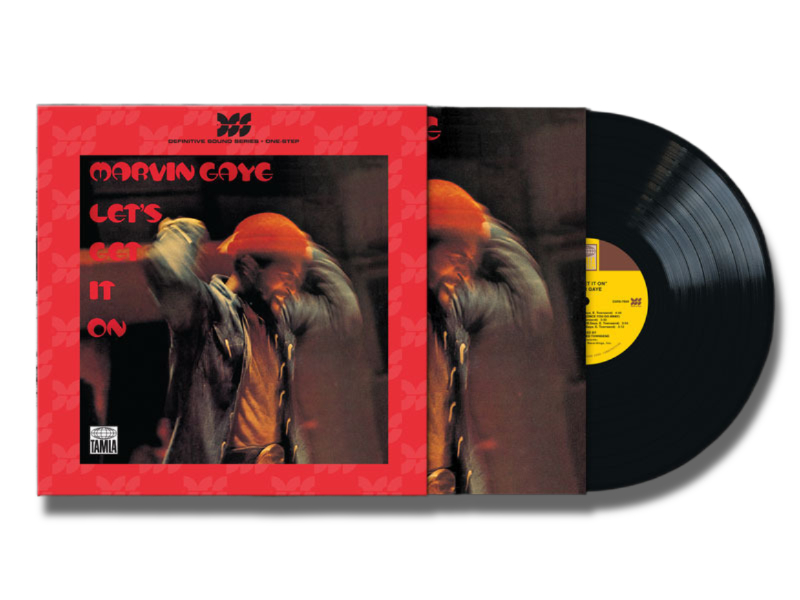
Marvin Gaye • Let's Get It On Tamla/Interscope Records DSS 11
It's hilarious stuff, guys in the know talking trash to each other. But Let's Get It On is hard to argue with, because both the track and album are classics and supreme make-out music -- they came to be shorthand for, well, you know. While the music is broadly considered soul/R&B, it has elements of funk, smooth jazz, and rock. Gaye does more with less than any singer of his generation. His voice is emotive in the extreme, dripping with carnal innuendo, but the little things -- shifts in volume, his amazing range and clean enunciation -- often convey more than the lyrics. The word that comes to mind is the most obvious one -- orgasmic -- but Gaye’s vocals also have some elements of vocalise, where the singer becomes another member of the band. This is yet another release in Interscope's Definitive Sound Series (DSS) of One Step releases. In the One Step process, the first metal part produced from the plating of the lacquer is used to press the records, reducing the overall operation by two steps and putting the records two steps closer to the master tape. It also means that fewer copies of each record can be produced -- only 3000 of Let's Get It On, each pressed at RTI with Neotech’s VR900-D2 “super vinyl,” which makes for greater groove detail and a quieter record. Chris Bellman at Bernie Grundman Mastering created the lacquers from the master tapes, so the release is all analog from beginning to end. Finally, the packaging from GPA Global is a handsome slipcase that holds the LP in its heavyweight gatefold sleeve.
The original Motown LP [Motown M5-192V1] impresses with its transient impact, from the treble down into the bass. But the One Step improves on it in important ways, delineating instrumental lines and making the original sound spatially compressed and hashy. Its impact is also greater -- it will get your pulse quickening and head bobbing. These are complex arrangements, built layer upon layer, like lacquer. The One Step process better reveals this along with the important timing that pulls the arrangements together. In all of these ways, it better serves both the recording and the music. Like all of the other DSS One Steps, the care that went into the creation of Let's Get It On is obvious, from the remastering to the packaging. That it improves on a decent-sounding original pressing in unsubtle ways is icing on the cake. As an artifact of its time and an announcement of music
as aphrodisiac, Let's Get It On is as important as they come. But I wonder if What's
Going On, Marvin Gaye's greatest artistic statement, is also in the queue. Although
Mobile Fidelity released it as a One Step, it's sold out; it was also a 45rpm double-LP
set with unnatural breaks in the music and a DSD step in the remastering. With an
all-analog single-LP One Step release, Interscope can right these wrongs. |



 he movie High
Fidelity was released in 1996, but it gets so much right about record collecting and
music connoisseurship in 2026. A recurring motif is the top-five list. In one, Rob, the
movie's main character, played by John Cusack, starts to rattle off “Top Five Side
Ones, Track Ones,” a list that begins with “'Let's Get It On,' Marvin Gaye, from
Let's Get It On.” He immediately takes flak from Barry, Jack Black's
character, for making a choice that's too easy: “Oh, no, Rob, that's not obvious
enough. Not at all.” He goes on, “How about, uh, 'Point of Know Return' on Point
of Know Return?” Then, with a sly chuckle, “How about fucking Beethoven?
Track one, side one of the Fifth Symphony?” He concludes with this zinger, “How
can someone who has no interest in music own a record store?”