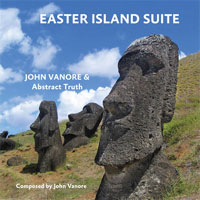
John Vanore & Abstract Truth • Easter Island Suite Acoustical Concepts Records AC-160-V
Vanore, leader of the big band Abstract Truth and composer of Easter Island Suite, hails from Philadelphia, where he picked up the trumpet at age seven. Later, with exposure to Oliver Nelson at Indiana University and a stint in Woody Herman’s trumpet section, Vanore became a much-in-demand trumpet player backing artists such as Tony Bennett, Nancy Wilson, Mel Torme and other A-listers. He became music director at Widener University, just outside Philly, where he established a jazz-ensemble program and was named an Artist in Residence. Abstract Truth, the 12-piece big band formed by Vanore in the 1980s and named in honor of his mentor Oliver Nelson, released a bevy of albums, including Blue Route and Curiosity. Concurrently, his talents as a producer were being recognized by labels such as EMI and Atlantic and networks like PBS and Miramax, where his work eventually forced him to put Abstract Truth on hold. The music of Easter Island Suite was 37 years in the making: the first movement “Discovery,” being penned in 1989, with movements two and three, “Gods and Devils” and “The Secret Caves” from 2012, and the final movement, “Rano Raraku,” written just two years ago. It is semi-symphonic in nature, recalling George Russell’s or Gil Evans’s best. The music is spread over three sides, the forth remaining blank. The somber French-horn/string-bass duet (courtesy of George Barnett and Craig Thomas, respectively) that opens “Discovery” was a first for me. The preciousness and beauty of that blend of dissimilar instruments lent a mysterious and haunting air to the musical journey about to unfold. A brief linear, free-flowing statement from the entire ensemble follows, ending abruptly, after which a tenor-sax/bass duo continues, saxophonist Mike Falcone displaying his substantial chops over a deliberate bass line. More free playing from Falcone, this time adding piano and drums, increases the intensity, finally leading to an ending by the full band recalling the opening theme. A solid statement from the full band over an insistent bass line opens “Gods and Devils.” Soon, Bob Howell’s tenor sax comes charging into the mix, his solo redefining just what the performance limits of a tenor sax might be. All this is heard over Don Monaghan’s crafty drumming. Leader John Vanore’s trumpet takes over with a rousing, fluid solo propelled by the guitar of Greg Kettinger and Craig Thomas’s bass. Bass clarinet, guitar and string bass gently open “The Secret Caves” before being joined by the entire ensemble for a fairly traditional romp. Before long, things turn mysterious thanks to the alto flute of Michael Mee and Craig Thomas’s waterphone. After an interval of reedy wailing and free-drumming, the piece returns to its initial theme and a rather abrupt ending. “Rano Raraku,” the fourth and final movement, opens with a spirited, chorale-like statement from the full band, showcasing Vanore’s composing skills. After a few cymbal strikes, the trumpet section states a languid theme, later augmented with fluid guitar, piano and bass. Fractured guitar, courtesy of Greg Kettinger with accents from piano and drums, continues with part two of this movement, after which the final section opens with a solo French horn stating a solemn theme, expanded by Ron Thomas’s solo on “treated” piano. It was easy to get lost in the beauty of this musical moment, and when the cartridge reached the dead wax, my ears wanted more. Acoustical Concepts Records’s presentation of Easter Island Suite is impeccable. The satiny, gatefold jacket is adorned, front, back and inside, with beautiful color photographs of the monumental Moai statues placed over 700 years ago by Polynesian settlers in the South Pacific territory of Rapa Nui (Easter Island). A brief history of the statues along with personnel listings for each of the Suite’s movements is found inside the jacket. The recordings that were to become Easter Island Suite date from October 1989, June 2012 and June 2024. All were mixed, mastered and received final assembly into album form by Vanore himself. The sound is dynamic, natural, revealing and devoid of any processing artifacts. The soundstage is tightly focused with good depth, lending a welcomed intimacy to the presentation. Though the pressing plant was not identified, there were no pressing issues and the vinyl was flat, clean and centered. If you enjoy the sound and impact of a big band and the
prowess of hand-picked soloists within it, you’ll find many things to like on Easter
Island Suite. John Vanore’s musical journey to that iconic island is one I
savored taking. |



 ack in the
day, Stan Kenton, Maynard Ferguson, Count Basie, Duke Ellington and Woody Herman LPs spun
regularly on my turntable. My goal as a young trumpet student was to sit in the brass
section of one of those bands. That never happened, but I spent many of my formative years
seated in the trumpet section of the Johnny Polzin Orchestra in St. Louis, where we
entertained the folks at the Chase-Park Plaza Hotel and the steamer ship Admiral.
The Chase Hotel still stands, now known as the Royal Sonesta Chase Park Plaza, but the Admiral
was sold for scrap in 2011 and bandleader Polzin has been dead for twenty years.
Bandleader/composer Maria Schneider and her ensemble, the Maria Schneider Orchestra, and
saxophonist/composer Sean Imboden’s the Sean Imboden Large Ensemble, carry on the
tradition of music made by more than just a handful of musicians. It’s now time to
add John Vanore to that short list. You can’t dance to it, but his music is as
compelling as a Shostakovitch symphony.
ack in the
day, Stan Kenton, Maynard Ferguson, Count Basie, Duke Ellington and Woody Herman LPs spun
regularly on my turntable. My goal as a young trumpet student was to sit in the brass
section of one of those bands. That never happened, but I spent many of my formative years
seated in the trumpet section of the Johnny Polzin Orchestra in St. Louis, where we
entertained the folks at the Chase-Park Plaza Hotel and the steamer ship Admiral.
The Chase Hotel still stands, now known as the Royal Sonesta Chase Park Plaza, but the Admiral
was sold for scrap in 2011 and bandleader Polzin has been dead for twenty years.
Bandleader/composer Maria Schneider and her ensemble, the Maria Schneider Orchestra, and
saxophonist/composer Sean Imboden’s the Sean Imboden Large Ensemble, carry on the
tradition of music made by more than just a handful of musicians. It’s now time to
add John Vanore to that short list. You can’t dance to it, but his music is as
compelling as a Shostakovitch symphony.