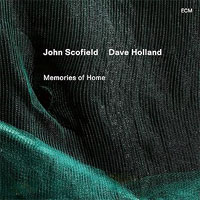
John Scofield & Dave Holland • Memories of Home ECM 2860/784 9960
It’s a stress-free setting; each reaches into his book for (overlooked) tunes to get the juices flowing: good rhythm, serviceable chords, and maybe a catchy melody (like Scofield’s 1990 “Meant to Be,” 1992 “Easy for You” and 2007 “Memorette”) or an irresistible bass vamp (“Not for Nothin’,” Holland 2000). Holland’s plaintive waltz “Memories of Home” comes from a newgrassy 1980s date with Vassar Clements fiddling and John Hartford on banjo. (Holland’s Woodstock neighbor, producer John Simon, had connected him to that crowd in the 1970s.) Scofield has his own country echoes, another point of correspondence -- just as Holland uses guitaristic hammer-ons and pull-offs, staples of Scofield’s legato style. His “Icons at the Fair” quickly reveals itself as “Scarborough Fair,” old English ballad popularized by Simon & Garfunkel in the 1960s (which ScoHo had recorded with Herbie Hancock). So when Scofield quotes the hook from Nat Adderley’s blues “Work Song” while trading phrases with Holland, he’s referencing Simon quoting same on a 1960s recording of Davey Graham’s picker’s test-piece “Anji”/”Angie.” (Simon had learned it from jazz-aware folkie Bert Jansch, who’d inserted that “Work Song” quote, which Simon then recycled into his throwaway “We’ve Got a Groovy Thing Goin’.”) I haven’t always given Scofield his due, but he pointed the way for countless followers, applying a discreet amount of rock-style distortion and sustain (and chorus effect), without giving up a front-loaded jazz-guitar attack. He’ll deftly slip between tuneful single-note lines and Wes Montgomery-inspired octaves, flat-picking the lower note and picking the higher string with a middle finger. His fluidity, easy melodicism and surging momentum make him a solid swinger, one who can also bring the funk. All that (the funk aside) makes him a good match for the bassist, ever revered for his pinpoint intonation, propulsive phrasing and perfectly placed beat. Holland’s breezy virtuosity is realized partly by the low action on his strings; when they lie close to the neck, a bassist can’t thump the hell out of them the way a 1950s champ did in order to project. Then again a modern bassist needn’t fight to be heard; now bass is (hopefully discreetly) amplified, even in the studio. That low-slung string sound has its own slinky esthetic, which Holland helped establish. After more than a half century ECM Records takes itself seriously as an institution, whose albums have a consistent look (sans-serif Arial font and a black-&-white photo, maybe placed over a solid background). The CDs are packaged as they were in the pre–eco 1980s: a plastic jewel box inserted into a tight redundant cardboard sleeve. ECM likewise remains committed to a cool glossy sound, notably its signature add-on reverb (used sparingly here), as well as a plugged-in bass sound: think of early ECM mainstay Eberhard Weber. Or listen to Holland’s 1972 quartet masterpiece Conference of the Birds: his amped timbre is the only dated aspect. If Holland sounds a little fortified on Memories of Home, it makes a good fit for plugged-in guitar. (There are a few moments -- Scofield comping for Holland on “Not for Nothin’” -- where we hear what sounds like pure string sound, close-miked.) Scott Petito recorded it at his NRS studio in Catskill,
NY, up on the Hudson in August 2024. The duo, billed as co-producers, sound alert and
relaxed. They don’t try to impress or crowd each other, or us -- animated
conversation in a shared language is more than plenty. |



 ohn Scofield and Dave Holland had been jazz stars for a couple of
decades before they began recording together in the early 1990s, at someone else’s
behest -- Joe Henderson, Herbie Hancock, Chris Potter, Roy Haynes -- and before forming
the co-op ScoLoHoFo with Joe Lovano and Al Foster. Now that the guitarist and bassist have
recorded as a duo, it’s a wonder it took so long: each is a master of the groove as a
concept, and of multifarious grooves in practice. You don’t miss a drummer.
ohn Scofield and Dave Holland had been jazz stars for a couple of
decades before they began recording together in the early 1990s, at someone else’s
behest -- Joe Henderson, Herbie Hancock, Chris Potter, Roy Haynes -- and before forming
the co-op ScoLoHoFo with Joe Lovano and Al Foster. Now that the guitarist and bassist have
recorded as a duo, it’s a wonder it took so long: each is a master of the groove as a
concept, and of multifarious grooves in practice. You don’t miss a drummer.