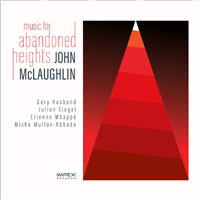
John McLaughlin • Music For Abandoned Heights
In 2018, film director Jack Stallings asked McLaughlin to compose and record a soundtrack for Abandoned Heights, a movie Stallings was producing. Stallings gave him complete control of the soundtrack project. McLaughlin began composing the music before filming commenced. Working from the script, McLaughlin composed ten numbers with titles inspired by chapter descriptions or characters. Although no known tunes are covered, throughout the album you hear riffs or suggestions of tunes from virtually every period of John McLaughlin’s storied career. The backing musicians on this session include Gary Husband on drums and keyboards, Julian Siegel on tenor and soprano saxophones, Misha Mullov-Abbado on acoustic bass, and Etienne Mbappé on electric bass. McLaughlin plays guitar and synth-guitar, and he did MIDI programming. McLaughlin and this group recorded the score in May 2019 at Eastcote Studios in London, with engineer George Murphy. The movie has yet to be released, and this is the first release of the soundtrack. Movie soundtracks are generally not my cup of tea, and over the years that section of my music collection has shrunk to a baker’s dozen of titles, as I weed out soundtracks that no longer interest me. There are some tasty morsels in that thinned-out collection, including Bullitt [Speakers Corner/Warner Bros 1777], Henry Mancini's Combo! [RCA LSP-2258], Chinatown [ABC ABDP-848], O Brother, Where Art Thou? [Lost Highway 088 170 069-1], Thelonious Monk's Les liaisons dangereuses 1960 [Saga/Sam Records SRS-1-LE], and The Fantasy Film World Of Bernard Herrmann [Decca PFS 4309]. But as stellar as each of these is, two titles have long floated above the fray as personal favorites: The Hot Spot [Antilles AN 8755] and Ascenseur Pour L’échafaud (Elevator to the Gallows) [Sam Records/Fontana 660.213]. John Lee Hooker and Miles Davis performed the film score for The Hot Spot, and Miles Davis was responsible for the Louis Malle classic Elevator to the Gallows, both of which share a noir sensibility that has burrowed into my psyche.
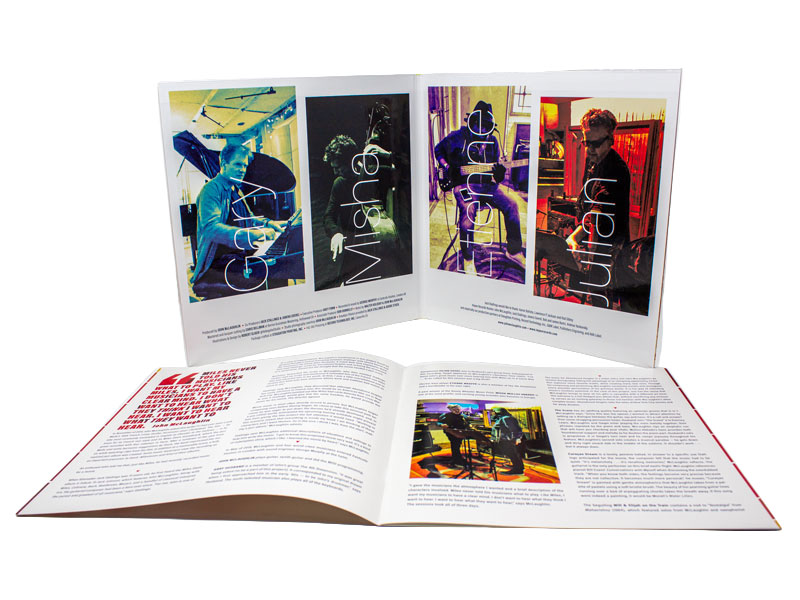
Abandoned Heights now joins my collection of favorite film scores. I’ve played it a dozen times, and it pins me to the listening seat from first to last. It shares a noir feel with my other two favorites, not surprising as McLaughlin and director Jack Stalling both consider Elevator To The Gallows among their favorite film scores. But this is a paler shade of noir, blending the sound of electronic instruments with the mystery film script. Despite McLaughlin being in his eighth decade, there is nothing about this music that suggests an autumnal mood. It’s the most engaging fusion album I’ve heard in an exceptionally long time. Part of the allure of the score is the sound. Columbia Records did not always serve McLaughlin well. In the 1970s, he recorded one great album after another, mostly music much hotter than that on this new album. It was music you wanted to turn way up in volume, but the quality of record production at that time (mastering, cutting, vinyl -- take your pick) sabotaged the sound of many otherwise fine recordings. This 24-bit/48kHz digital recording sounds phenomenal and can be played at whatever volume your gear can accurately reproduce. Chris Bellman of Bernie Grundman Mastering cut the lacquers and mastered the LP. The vinyl was pressed at RTI. It’s among the finest-sounding jazz-fusion recordings available. The music is also available on SACD, although I have not heard that version. The record is packaged in a foldout cover from Stoughton Printing with an eight-page insert containing short essays from McLaughlin and music historian Walter Kolosky. Abey Fonn of Impex and her crack team designed the package; special congratulations are due to graphic artist Robert Sliger for the cover design and illustrations, which are simple but elegant. In short, this is a very well-recorded session of
exceptional music from one of the great jazz artists of our time. |



 veryone remembers their first time, or so the saying
goes. Of course, I am talking about the first time you discovered jazz. For me, it was in
1969, and at that time I was a bit of a classical-music snob. Of course, I knew who Miles
Davis was, and I even owned the obligatory copy of Kind of Blue. Still, it was
not until the release of In A Silent Way, Davis’s first electric-period
album, that I became hooked on jazz. Among the musicians on that session was guitarist
John McLaughlin, recently emigrated from Britain, who went on to play a huge role with
Miles Davis during this period. In addition to recording with Miles Davis, McLaughlin has
recorded albums with his own groups, including the Mahavishnu Orchestra and Shakti, and
under his own name. He recorded and toured with Paco de Lucia and Al Di Meola as The
Guitar Trio, and Impex has released two of their albums. In addition, McLaughlin has long
been an in-demand session player for both jazz and pop musicians at the top of their game.
He is considered one of the best guitarists of all time.
veryone remembers their first time, or so the saying
goes. Of course, I am talking about the first time you discovered jazz. For me, it was in
1969, and at that time I was a bit of a classical-music snob. Of course, I knew who Miles
Davis was, and I even owned the obligatory copy of Kind of Blue. Still, it was
not until the release of In A Silent Way, Davis’s first electric-period
album, that I became hooked on jazz. Among the musicians on that session was guitarist
John McLaughlin, recently emigrated from Britain, who went on to play a huge role with
Miles Davis during this period. In addition to recording with Miles Davis, McLaughlin has
recorded albums with his own groups, including the Mahavishnu Orchestra and Shakti, and
under his own name. He recorded and toured with Paco de Lucia and Al Di Meola as The
Guitar Trio, and Impex has released two of their albums. In addition, McLaughlin has long
been an in-demand session player for both jazz and pop musicians at the top of their game.
He is considered one of the best guitarists of all time.