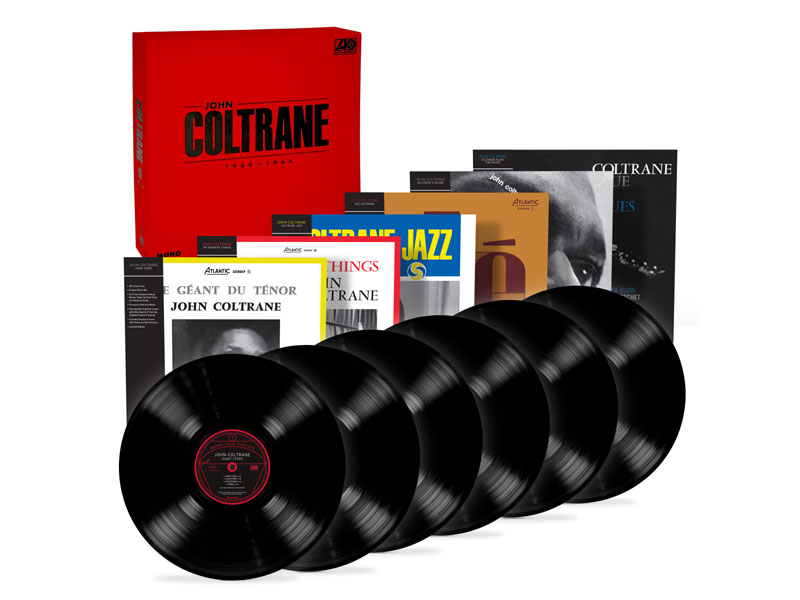
John Coltrane • 1960-1964 Atlantic Records/Rhino RFH1 3435
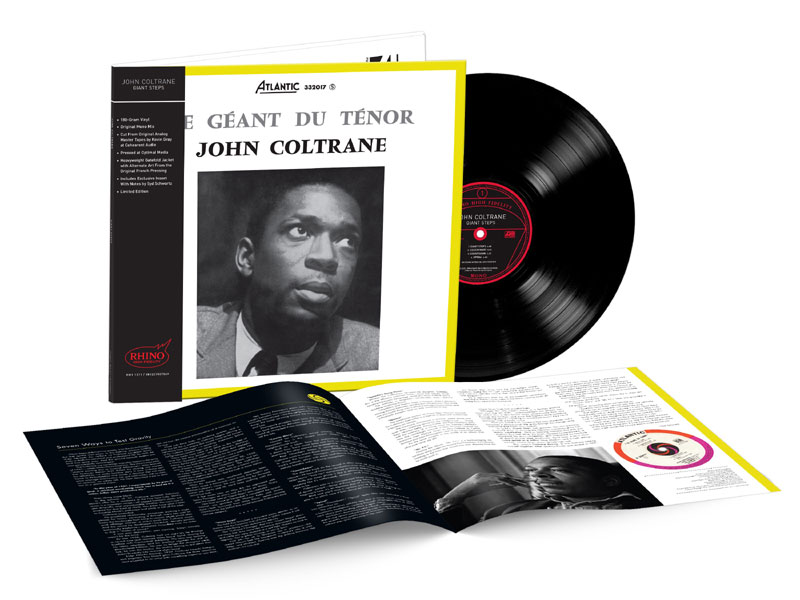
uring his unfortunately shortened career, John Coltrane recorded as a leader for three different labels. His early recordings for Prestige, including Coltrane, Settin' the Pace, and Soultrane, are considered hard-bop classics. His later recordings for Impulse! include boundary-pushing and experimental titles that various listeners consider a hit (A Love Supreme) or miss (Om). In between are his Atlantic recordings, which he began making in the late 1950s. They are, as a group, my favorites, and I'm not alone. Among Coltrane's most popular titles, and the easiest to find used, are Giant Steps, My Favorite Things, and Coltrane Jazz. All three are part of this deluxe set, along with three others that were nearly as well received: Olé Coltrane, Coltrane Plays the Blues, and Coltrane's Sound. These six recordings helped establish John Coltrane's primary place in jazz history. Five of the six feature only his compositions, while the sixth is an album of expansive covers. The series began with a bang in 1960 with the release of Giant Steps. The title track is one of the most challenging to play because of its intricate chord progressions. My Favorite Things, from the following year, was the first with the lineup of pianist McCoy Tyner, bassist Steve Davis, and drummer Elvin Jones. Coltrane played soprano sax on two of the four tracks, revealing new facets of his musicianship. Also released in 1961 are Olé Coltrane and Coltrane Jazz, followed by Coltrane Plays the Blues, and Coltrane's Sound in 1962 and 1964, respectively. All four include long pieces, especially Olé Coltrane, which has only three cuts. What made John Coltrane a figure for the ages is on ample display in this half-dozen albums: his immense instrumental prowess and ability to convey emotion in his playing, his trademark muscular tone, his complex melodic and harmonic improvisations, and his desire to experiment, often via his own compositions. Throughout these albums you hear a musician who is continuing to grow in important ways, while also laying down some of the music that brought jazz into the artistic and cultural mainstream. There are several boxed sets of John Coltrane's recordings, including some from Rhino: the twelve-LP Heavyweight Champion [Atlantic/Rhino R1 71984] collects all of Coltrane's Atlantic albums, and The Atlantic Years - In Mono [Atlantic/Rhino 0081229946401] features four of the six LPs here, and in mono too. But there are several things that set this new collection apart from those earlier ones. It is from Rhino's High Fidelity series, which is over two dozen releases and growing, each described as “high-end, limited-edition vinyl reissues of classic albums [that] represent the pinnacle of sound and packaging.” These LPs feature Kevin Gray's remastering and cutting of the lacquers from the mono analog master tapes, and they are 180-gram pressings from Optimal Media in Germany. The jacket of each LP has not the well-known US graphic but the much rarer French cover, and each includes a colorful large-format insert with information on the album written by a noted critic. Everything fits snuggly in a sturdy and handsome linen-covered box, and the LPs include obi-like end covers that add to the sense of uniqueness.
The pressings are super quiet, and while the tip-on gatefold jackets are not replicas of the fold-over French jackets, they are heavy and glossy, and they would look great framed. When played with a mono cartridge, the LPs sound vivid, deftly resolving instrumental presence and recorded space, reminding me of a phrase JVC used for its XRCDs, “big mono,” which describes not just the sound of the musicians but also the overall reaction to the easy resolution of the format. I have only an original mono pressing of My Favorite Things [Atlantic 1361] for comparison. It would be quick and easy to say that the Rhino reissue sounds more detailed, but that doesn't fully capture the kind and extent of the differences. Instrumental lines are better delineated, the bass has greater dynamic shading and contrast, and the soundscape is airier and deeper. The reissue has a more contemporary sound than the original pressing, and it's a better complement to today's high-resolution audio systems, while the original pressing sounds squeezed spatially, which obscures musical detail.
Rhino has been selling this set exclusively on its
website, and it appears that the run of 2000 has sold out. Keep the faith, though, because
Rhino has re-released titles from its High Fidelity series as unnumbered copies, and you
can buy all of these mono LPs, with French covers and extensive liner notes, separately. Coltrane's
Sound and Olé Coltrane are also available from Rhino High Fidelity, in
stereo with the US covers. |