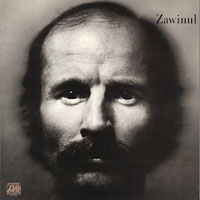
Joe Zawinul • Zawinul Atlantic Records/Speakers Corner SD 1579
Miles Davis recruited Zawinul in the late 1960s to participate in the groundbreaking albums In A Silent Way, Bitches Brew, and Live-Evil. Even though Zawinul had issues with the treatment of his composition “In A Silent Way” on the 1969 album of the same title, his association with Miles Davis propelled him into the first rank of what was to be called jazz-fusion and the formation of his own group, Weather Report, co-led by saxophonist Wayne Shorter (also a former member of Maynard Ferguson’s big band). Zawinul, first released in 1971 on Atlantic Records, was the beginning of the future super group Weather Report. Indeed, a couple of future Weather Report members appear here, including Miroslav Vitous and Wayne Shorter. Also in attendance were other celebrated musicians, Jack DeJohnette and Hubert Laws. The dual keyboards of Zawinul and Herbie Hancock, utilizing a variety of electronic effects including the Echoplex and ring modulator, along with two drummers, two bassists, flute, trumpet and soprano saxophone, brought a new and exciting sound to an audience eager to experience something different. And something different it was. The album opener, “Doctor Honoris Causa," rises from the silence and evolves into a drone-like procession with an insistent rhythm coming and going like a moth around a point of light. The horns state a broken melody over strummed basses, reaching a climax at approximately the five-minute mark, where underappreciated trumpeter Woody Shaw begins his free-form solo. After a brief interlude, Earl Turbinton takes over with a short, unrestrained soprano-sax solo. More ensemble, then Zawinul solos on electric piano followed by a rather unexpected ending. Next up is a repeat appearance of the complete, unadulterated version of “In A Silent Way,” the Zawinul composition Miles Davis had earlier appropriated. Unlike the vamps and grooves of that version, the tune here becomes a thing of beauty -- an elegy framed by electric pianos, plucked acoustic basses and soprano saxophone. “His Last Journey” arises out of silence and is a pensive, atmospheric ode to Zawinul’s impressions of his grandfather’s funeral. “Double Image” and “Arrival In New York” conclude the album with a wild, pulsating ensemble jam with, respectively, frantic drums, spastic electric piano, challenging bowed acoustic bass, and an amazing musical reconstruction of an actual steamboat at sea. I did not have access to the George Piros-mastered first
pressing of this album for comparison, but I could find nothing wrong with the Kevin Gray
mastering on this immaculate, Pallas-pressed, heavyweight reissue. Though the sound was
not what I expected at first, it became more appealing on subsequent listens. Just as my
ears came to adjust to the sounds of the then new fusion jazz, they also adjusted to the
engineered manipulation of the musicians’ music-making and the compact, tidy
presentation of the Atlantic engineers. With the exception of a poly-lined inner sleeve
replacing the printed original, the Speakers Corner packaging is first-rate and true to
that of the 1971 debut, down to Miles Davis’s liner notes. Zawinul is not
your everyday listen, but it will massage your ears in new and unique ways. |



 first became aware of late
Austrian keyboardist and composer Joe Zawinul when he was holding down the piano chair in
Maynard Ferguson’s late-1950s big band. In that organization, his hard-bop style
complemented the often rowdy, brass-heavy band and its unrestrained leader. He was later
associated with Dinah Washington, Herbie Mann, Yusef Lateef, Nat Adderley, and, most
significantly, Cannonball Adderley, in whose quintet his composition ”Mercy, Mercy,
Mercy” achieved commercial-hit status.
first became aware of late
Austrian keyboardist and composer Joe Zawinul when he was holding down the piano chair in
Maynard Ferguson’s late-1950s big band. In that organization, his hard-bop style
complemented the often rowdy, brass-heavy band and its unrestrained leader. He was later
associated with Dinah Washington, Herbie Mann, Yusef Lateef, Nat Adderley, and, most
significantly, Cannonball Adderley, in whose quintet his composition ”Mercy, Mercy,
Mercy” achieved commercial-hit status.