Irène Schweizer, Rüdiger Carl, Johnny Dyani, Han Bennink • Irène's Hot Four
Schweizer’s quartet wasn’t entirely European -- bassist Johnny Dyani was one of several black South Africans who made their mark on UK and continental scenes, bringing their own folkways (tunefulness, useful organizing principles) to the mix. His throbbing bass is the band’s heartbeat, when his bowing isn’t thickening the background. Three of these players at least draw on the jazz they all had in common -- jazz being improvising’s 20th-century home. Even Euro improvisers who claimed to be done with jazz still played sequential horn solos over piano, bass and drums. Calling this album Irène’s Hot 4 (a band name out of the 1920s or ’30s) declares her proud jazz roots. The early piano greats had strong rhythmic left hands; Schweizer loved bobbing old-school two-beat (and waltzing three-beat) bass patterns, but also played quick leaping low figures in sturdy octaves, atonal boogie-woogie à la Cecil Taylor. The rolling gospel cadences of South Africa’s Abdullah Ibrahim might peek out as well. But her style had its own lean clarity and overt humor. European folkways are represented by saxophonist Rüdiger Carl, Schweizer’s sometime duo partner. Born in what’s now northeast Poland, Carl largely avoids jazz phraseology on soprano, alto or tenor, even when riffing on a spontaneous motif. He also brought along his Euro-coded accordion, for a bit of chording, fluttering, honking or (non-bluesy) train-chugging. Dutch drummer Han Bennink meanwhile swings madly like his jazz heroes, when not disrupting things away from the traps, yelling through his megaphone or (at the top of the encore) playing surprisingly adept note-bending tongue-stopping country bluesy harmonica -- another link to musical Americana. Bennink’s gifts include a sure feel for when to cut an episode off before it burns itself out. He has ways of deflecting or deflating things in a hurry, sometimes simply by falling silent, opening up the texture. At such moments his old friend (and occasional duet partner) Schweizer, a drummer herself, might take over the percussion part on grand piano, after laying something over the strings to quickly mute them, to sound more clipped and drumlike. There are moments when each member of the quartet intervenes to initiate a new strategy, tempo or texture, from spare dappled pointillism to slow pastorales to high-energy bust-outs. Over three long spontaneous suites (plus a seven-minute encore that tips their set over an hour) you get a lot more variety than on a typical jazz gig, American or otherwise. The action can be so dizzying, you occasionally have to stop to suss out who’s playing what. A few vignettes may suggest their range. Dyani begins a down-home vocal chant, and Bennink joins him in friendly call-and-response, via megaphone, and then Schweizer joins in , her lean piano line a third melodic voice, three lines braided. A little later on the same piece, “All Inclusive,” Bennink hears Schweizer slipping into Abdullah Ibrahim-mode, and heads her off before she can get started. On the opener “Reise” -- A Trip -- the quartet slide into a left-right-leftrightleft “street beat” that sounds lifted from a then-current Anthony Braxton march. A moment before, Dyani and Bennink had made a conceptual pun they may not even have noticed: the bassist slowly strums an ascending three-note figure echoing the bugle call “Taps,” as Han plays the stage floor with drumsticks, in tap-dancer rhythm. Radio engineers working major festivals record under
pressure: they have to arrange mics quickly and repeatedly for various lineups, maybe
while staying out of the way of other techs providing sound for the hall. Sound recorded
by anonymous staffers from Swiss broadcasting’s German-language division (mixed and
mastered in 2023 by Michael Brändli) is good, catching Bennink’s occasional antics
away from the drums, with only minimal audience rustling heard in quiet passages. Whether
Dyani plucks or bows, his amplified bass sound is rubbery in the period fashion.
Esoterica: Bernhard Arndt had caught the bassist’s arco sound better, on his
“Soweto-Simbabwe-Mississippie-Child-Cry” recorded at Berlin’s 1977 Workshop
Freie Musik, but on that night Dyani was playing solo, and FMP’s recordists knew
whatever they caught might turn up on record. Jazz fest radio engineers are usually happy
just to get through the night. Tomorrow they’ll be doing it all again. |



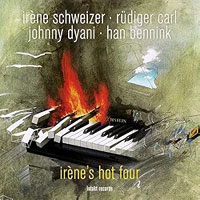 his newly released 1981
Jazzfestival Zurich set by the dynamic Swiss pianist (and feminist improvising icon)
Irène Schweizer, who died in 2024, is a superior example of so-called European improvised
music, a term that popped up in the late 1960s, a nominal break with American free jazz.
In reality it’s an international style open to all, where (shortest version) any
improvisers may tap into their folk roots the way American free jazz is infused with the
subtleties of the blues.
his newly released 1981
Jazzfestival Zurich set by the dynamic Swiss pianist (and feminist improvising icon)
Irène Schweizer, who died in 2024, is a superior example of so-called European improvised
music, a term that popped up in the late 1960s, a nominal break with American free jazz.
In reality it’s an international style open to all, where (shortest version) any
improvisers may tap into their folk roots the way American free jazz is infused with the
subtleties of the blues.