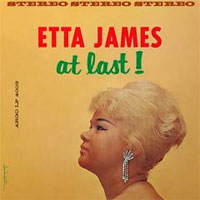
Etta James • At Last!
Thus, when Acoustic Sounds announced its series of Chess Records reissues more than 15 years after the fire, it was cause for jubilation, for several reasons. First, Chess produced some of the greatest LPs of the 20th century, and many of these records influenced much of what we now know as rock 'n' roll. Second, finding decent original pressings of Chess records was difficult, and the prices for choice copies were sky high. The first two releases in the Acoustic Sounds series were The Best of Muddy Waters and Etta James's At Last! The Muddy Waters title was a no-brainer -- it's one of the greatest blues albums ever released. On top of that, a clean black-label original will cost well into three figures, and original pressings were becoming truly hard to track down. A third reason why these records are important is that their availability educates younger listeners about this important music. The Internet is filled with “experts” who form their opinions without actually listening to the music or being familiar with its history. For example, one opinion I’ve seen oft repeated is that the Muddy Waters release was inferior because it is merely “a compilation.” Etta James LPs are now in less demand from collectors than many other Chess titles (especially the compilations), but I was excited to see that Chad Kassem placed quality over collector demand in choosing At Last! as one of the first two releases in his Chess series, as it is truly an indispensable title begging for a top-notch reissue. Etta James had a long and storied career. Her performances blended doo-wop, R & B, gospel, blues, jazz, and pop. Born in 1938, she began performing in her early teens, and she continued performing and winning awards until about a year before she died in 2012. James recorded singles for Modern Records during the 1950s and performed with the likes of Little Richard, B.B. King, and Elvis Presley. In 1960, she signed with Chess and became one of the label’s stars. She performed regularly throughout her life, with some slower periods resulting from drug addiction. I caught her act on a few occasions during her regular performances at the San Francisco Blues Festival and later SF Jazz. Her records were initially released on Chess's Argo subsidiary label until the Chess brothers learned that there was already an Argo Records label (in the UK). At Last! was Etta James's first album, and it's among the best of the Chess family releases. Of her records, At Last! is among my two favorites, along with Rock The House, one of the great live recordings of any genre. At Last!, on the other hand, is every inch a studio recording. Backed by a full orchestra on several songs, and a smaller ensemble on others, James struts through ten exceptional numbers without coming up for air and without a hint of filler. Side one of the LP will hold you slack-jawed, but flip the disc and side two will knock you back a few paces. It opens with Willie Dixon’s “I Just Want To Make Love To You,” perhaps best known for the Muddy Waters version. How does the sound stack up to that of other pressings? Chess (and its Argo sub-label) never approached the mastering or pressing quality of today’s top releases. The pressing quality was consistently good; as with several other pressings from the 1960s, you could often find a used copy showing a lot of surface wear that still played clean with few, if any, ticks or pops. However, the originals had “in your face” sound that was immediately identifiable as a Chess recording. That sound served the spirit of Etta James’s delivery, but the brashness made for somewhat ugly orchestral sound. I’ve owned original mono and stereo pressings of this record, but I felt the 2011 Speakers Corner reissue [Argo/Speakers Corner 4003] cleaned up the grunge enough to make that reissue a better listening experience than an original pressing, even though Speakers Corner was likely working from a production master tape a generation removed from the actual master. This Acoustic Sounds reissue, however, takes the recording to another level. With every other copy I’ve owned, the backing musicians (especially on those cuts using a full orchestra) sound two-dimensional and at times shrill. This wonderful new reissue, mastered by Matthew Lutthans at the Acoustic Sounds Mastering Lab and pressed at Quality Record Pressings, makes you forget about the second-rate string section and focus on James. I’ve owned many of her records, and her voice has never sounded better than it does here. There are probably plenty of audiophiles among us who
never heard of Etta James and wonder why Chad Kassem chose to put her in his first round
of Chess reissues. When you think of Chess Records, most think Muddy Waters, Howlin’
Wolf, and Sonny Boy Williamson, but Etta James belongs in that rarefied company. She rolls
up everything I love about blues singers like Big Maybelle and Big Mama Thornton, tosses
in a little Aretha and Staples Singers, and produces a unique and incomparable mixture of
the blues, R&B, and gospel. With this, her greatest studio recording, Etta James and
Acoustic Sounds have created an indispensable reissue that should be on every record
collector’s shelf. |



 une 1, 2008,
brought shocking news for music lovers and especially for record collectors. A fire broke
out on a back lot of Universal Studios in Hollywood. It started burning through various
filming locations but soon spread to a warehouse called “the video vault,” a
space that stored not just video tapes but a large part of Universal’s library of
music master tapes. Over the next few weeks, it became clear that the facility was the
repository of tapes for, among many other labels, Impulse, Decca, and Chess. The initial
shock had music lovers fearing that many of their favorite albums would never see another
high-quality issue from the original tapes. Before long, most of us realized that perhaps
the most sought-after titles had probably not gone up in smoke, as the masters had a
chance of being out of the vault on loan to mastering studios.
une 1, 2008,
brought shocking news for music lovers and especially for record collectors. A fire broke
out on a back lot of Universal Studios in Hollywood. It started burning through various
filming locations but soon spread to a warehouse called “the video vault,” a
space that stored not just video tapes but a large part of Universal’s library of
music master tapes. Over the next few weeks, it became clear that the facility was the
repository of tapes for, among many other labels, Impulse, Decca, and Chess. The initial
shock had music lovers fearing that many of their favorite albums would never see another
high-quality issue from the original tapes. Before long, most of us realized that perhaps
the most sought-after titles had probably not gone up in smoke, as the masters had a
chance of being out of the vault on loan to mastering studios.