Ensemble C • Every Journey Adhyâropa Records AR00078
The album’s opener, “Every Journey (Has a Beginning),” whose title acknowledges the self-doubt and difficulty of taking those first steps into new adventures, begins softly and tentatively, featuring Brigitte Beraha’s wordless vocals against a drum intro. It quickly segues into a guitar solo, evolving later with the full 11-piece ensemble and choir backing. A duet with guitar and voice develops, the cut finally belonging to guitarist Ant Law. Brigitte Beraha’s voice is stunning -- moving rapidly, flitting, like a butterfly in flight. It reminded me of Flora Purim’s best efforts in Chick Corea’s Return to Forever. “Flight,” inspired by Bessie Coleman, the first African American/Native American woman to earn her pilot’s license in the US, is a jaunty, soaring excursion in Latin rhythms again featuring Baraha’s voice. She sings the angular melody along with the entire ensemble before tenor saxophonist Matt Carmichael takes his turn soloing against the energetic rhythm section. Leader Cope follows, soloing dramatically on piano. The piece evolves into a surging, urgent drive forward before ending abruptly and without warning. Side two opens with “The Birch and the Larch,” inspired by a fable drawn from the Jacki Hill-Murphy biography of Kate Marsden, the infamous British nurse who, in the late nineteenth-century, spent almost a year making her way across Russia to find a cure for leprosy. An incessant, two-note phrase on the piano leads into Brigitte Beraha’s vocal carrying the tune. Her vocal skills are on clear display here as she brings the poignant lyrics (courtesy of Ms. Beraha) to life. The song builds strength until Mike Soper’s fine, liquid flugelhorn solo takes off. Cope’s piano interlude leads into a poignant look back with Beraha’s vocal before the ensemble erupts into a brief climax before returning to the initial two-note phrase. String bass, percussion and guitar open “Isabel,” named for Isabel Godin des Odonais, the first woman known to travel the length of the Amazon river, grabbing your attention with an energetic, Latin-flavored beat. As elsewhere, Brigitte Beraha’s voice dominates the music. Her stunning wordless vocals, supported by the entire ensemble, give way to inspired solos from trombonist Anoushka Nanguy, baritone saxophonist (and husband) Rob Cope and trumpeter Freddie Gavita. Along the way, we are treated to some very nice percussive accents courtesy of Jack McCarthy. "The Light of the Dark” opens chorale-like with Cope’s piano soon joined by the entire ensemble and Brigitte Beraha’s wordless vocals. The tune moves deliberately towards its conclusion. Clarinet and voice introduce “Amboseli,” named for a Kenyan National Park located in the shadow of Mount Kilimanjaro. Shortly, a subtle beat develops along with Matt Carmichaels’s tenor sax. The organic nature of the piece lends itself to dramatic growth, the entire group shouting, joyfully, in unison toward the finale, though not before Cope’s piano and Beraha’s voice speak. Carmichael’s tenor sax returns at the end to usher in the night over the park. “That Nabongo Feeling” honors modern-day explorer Jessica Nabongo, who recently became the first Black woman to visit all 195 of our globe’s countries. The song is introduced with a jaunty, catchy rhythm set down by Cope, bassist Gavin Barras and drummer Jon Ormston, and features Beraha’s voice soaring over the ensemble. Freddie Gavita turns in a top-flight trumpet solo followed by Rob Cope on baritone sax. The song develops into a vigorous workout for the entire ensemble, with Law’s guitar and Beraha’s voice adding deft musical exclamation marks to the proceedings before the abrupt ending. Cope’s persistent eight-note piano figure begins the heartfelt “Home,” featuring Beraha’s wordless vocals in unison with the ensemble as the piece unfolds. The somber tone is replaced by the rhythm section’s subtle beat as Beraha’s voice takes over. She is soon joined by Mike Soper’s mellifluous flugelhorn for a stunning duet before the song evolves into a joyous roar. Calm returns via Cope’s piano floating above the rhythm section as the tune fades out to its end. I found this album calming and refreshing, a pleasant
detour from some of the more “noisy” music I’ve been listening to lately.
Thankfully, the music is captured in a nuanced recording of exceptional quality. The
recording, easy on the ears due to quiet surfaces and precise mastering, lures you into
Claire Cope’s vision. If you’re looking for music that will elevate your mood,
you need look no further than this two-LP set. |



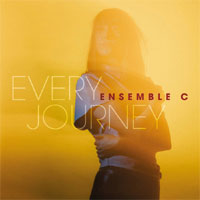 was unaware
of the musical aggregation Ensemble C before I received this album, the group’s
second, for review. Claire Cope, the leader and composer of all songs on the self-financed
album’s four sides, is a British musician and pianist who has gained increasing
recognition. Every Journey comes five years after Cope's internationally praised
debut album, Small World. The new album was released on March 7, concurrent with
International Women’s Day. This was not coincidental, as Claire Cope drew much
inspiration from stories collected in the works of writer/explorer Jacki Hill-Murphy.
Those tales of trailblazing women from the 18th and 19th centuries formed the seeds from
which many of the eight compositions on this album grew. Musically, the influence of
multi-Grammy Award-winning American composer Maria Schneider looms in the background. Every
Journey is an eclectic mix of "new" jazz, ambient and contemplative vocal
music. It is released on the New York-based, artist-owned record label Adhyâropa Records,
a four-year old collective that supports musicians who cannot be pigeonholed by a genre or
style. The label not only allows them complete control over the production and making of
their music, but financial authority and ownership of it. Adhyâropa Records represents
over fifty artists serving up an eclectic mix of musical styles.
was unaware
of the musical aggregation Ensemble C before I received this album, the group’s
second, for review. Claire Cope, the leader and composer of all songs on the self-financed
album’s four sides, is a British musician and pianist who has gained increasing
recognition. Every Journey comes five years after Cope's internationally praised
debut album, Small World. The new album was released on March 7, concurrent with
International Women’s Day. This was not coincidental, as Claire Cope drew much
inspiration from stories collected in the works of writer/explorer Jacki Hill-Murphy.
Those tales of trailblazing women from the 18th and 19th centuries formed the seeds from
which many of the eight compositions on this album grew. Musically, the influence of
multi-Grammy Award-winning American composer Maria Schneider looms in the background. Every
Journey is an eclectic mix of "new" jazz, ambient and contemplative vocal
music. It is released on the New York-based, artist-owned record label Adhyâropa Records,
a four-year old collective that supports musicians who cannot be pigeonholed by a genre or
style. The label not only allows them complete control over the production and making of
their music, but financial authority and ownership of it. Adhyâropa Records represents
over fifty artists serving up an eclectic mix of musical styles.