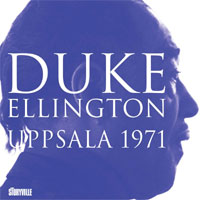
Duke Ellington • Uppsala 1971
 uke Ellington’s
work in his final years -- he died in 1974 -- gets scant attention. By 1971, his great
long and short works were behind him, and he’d lost his two key associates,
co-composer Billy Strayhorn, who died in 1967, and signature alto-saxophone soloist Johnny
Hodges, who passed in 1970. So it’s a shock to hear how good the orchestra sounds on Uppsala
1971, recorded in Sweden during Duke’s second-to-last European tour. (The tape,
presumably of a broadcast, was retrieved from his private stash.) The band still crackles,
and had hardly run out of great soloists. His writing had fallen off, but nobody had a
stronger book of oldies to fall back on. Rare among great 20th-century composers,
Ellington wanted to give audiences a real show -- mindful that any crowd would include
Ducal diehards, casual fans who’d recognize a brace of his hits even if they
couldn’t always name them, people who didn’t know him from Dave Brubeck or Guy
Lombardo, and young folks dragged along by their parents. Ellington aimed to have
something for all of them, as Uppsala 1971 makes abundantly clear. uke Ellington’s
work in his final years -- he died in 1974 -- gets scant attention. By 1971, his great
long and short works were behind him, and he’d lost his two key associates,
co-composer Billy Strayhorn, who died in 1967, and signature alto-saxophone soloist Johnny
Hodges, who passed in 1970. So it’s a shock to hear how good the orchestra sounds on Uppsala
1971, recorded in Sweden during Duke’s second-to-last European tour. (The tape,
presumably of a broadcast, was retrieved from his private stash.) The band still crackles,
and had hardly run out of great soloists. His writing had fallen off, but nobody had a
stronger book of oldies to fall back on. Rare among great 20th-century composers,
Ellington wanted to give audiences a real show -- mindful that any crowd would include
Ducal diehards, casual fans who’d recognize a brace of his hits even if they
couldn’t always name them, people who didn’t know him from Dave Brubeck or Guy
Lombardo, and young folks dragged along by their parents. Ellington aimed to have
something for all of them, as Uppsala 1971 makes abundantly clear.
For the diehards, there’s a revival of the major work "Harlem," in and out of the band’s book since 1951, when four of the musicians touring with the band 20 years later were already on board. It’s steeped in the blues from the opening notes: Cootie Williams wah-wahs the title using a plunger mute, the second note a minor-third fall from the first. But its main theme, heard in several moods, is built (like many great Ellington melodies) on a pentatonic scale, linking it to the old spirituals, with their echoes of West Africa. There are also shouting subthemes and transitions, solo spots, and a Latin segment: Duke always stressed the variety of cultural experiences contained within black and brown Manhattan. He was a lifelong believer in the mingling of the social classes -- hence the music’s highbrow/lowbrow mix -- and the orchestra itself was a not always placid combination of churchgoers and hell-raisers. A typical Ellington orchestration put that multiplicity of rich individual voices on proud display, sometimes one at a time. Here Paul Gonsalves gets the tenor saxophone ballad "Happy Reunion," while Harold Ashby plays the kind of tenor rave-up ("Chinoiserie") a younger Gonsalves used to blast. Norris Turney had the unenviable job of taking over Hodges’ chair. On alto saxophone he was a pale facsimile, but Turney played good flute, an instrument Duke had never written for (maybe because unofficial rival Count Basie had made it a signature in the 1950s). Turney's flute feature "Fife" starts as a ballerina’s waltz before breaking into another Gonsalves-style steamer. (Duke was also a believer in lightning striking more than once.) The classics "C Jam Blues" and "Rockin’ in Rhythm" let a bunch of soloists pop out, and show off the glorious ensemble sound, in particular the sonic depth of the reed-section voicings. Melody and countermelody, the emphatic and faraway, the crisp and the penumbral are exquisitely balanced. (This despite section blends often designed to let you hear the individuals within.) The guys knew how to modulate their own sound on stage, in all sorts of rooms. Beyond that, by 1971, European broadcasting crews had plenty of experience miking and mixing American jazz bands for TV and radio, and knew their business; preserving the music for posterity is a bonus. To head off requests, Duke had his nightly hits medley;
the one here is a concert in itself, 14 numbers in 18 minutes (followed by its own mini
encore), dragging in all manner of approaches. The pianist/leader touches on six tunes in
the first couple minutes; there’s a sing-along/clap-along for band and audience
("I’m Beginning to See the Light"). Singer Tony Watkins’s overwrought
baritone is heard down tempo and up, and Nell Brookshire testifies on "I Got It
Bad," with its gorgeous background voicings; bari saxist Harry Carney
circular-breathes one endless A-flat on "Sophisticated Lady" until he finally
gets a hand; and there’s lots more punchy piano. (Duke was in a mood to play: stompy,
or tender on Strayhorn’s "Lotus Blossom.") Beyond the medley, for the
rubes, there’s a throwaway "Hello Dolly," in tribute to Louis Armstrong
who’d passed four months earlier. And for the youngsters, one of Duke’s
endearingly not-wholly-convincing rock-and-soul tunes, "One More Time for the
People," with Brookshire’s gospel vocal and Ashby’s R&B tenor -- the
title a declaration of why Duke kept going back on the road one more one more
time. |