Dave Brubeck Quartet • Time OutTakes
 t can be hard to
separate Dave Brubeck’s first excursion into playing odd meters, 1959’s
celebrated Time Out, from how it was promoted: as if playing in 5/4 or 9/8 were
rocket science. The liner notes call the music “the result of weeks of concentration
on a particular problem.” I have written before about the contrast between the
quartet’s “Take Five” and Max Roach’s blues “As Long As
You’re Living,” recorded around the same time, where the drummer’s quintet
makes 5/4 jamming sound fluid and offhand. But it didn’t attract a hundredth of the
attention of the more self-consciously “difficult” “Take Five” --
Roach made it sound too easy. (It’s just alternating bars of 3/4 and 2/4, after all
-- not so complicated.) Time Out’s notes also tell us Brubeck plays the 5/4
vamp all through “Take Five” so listeners wouldn’t get lost -- but
he’s also marking the time for the band whether they need it or not. t can be hard to
separate Dave Brubeck’s first excursion into playing odd meters, 1959’s
celebrated Time Out, from how it was promoted: as if playing in 5/4 or 9/8 were
rocket science. The liner notes call the music “the result of weeks of concentration
on a particular problem.” I have written before about the contrast between the
quartet’s “Take Five” and Max Roach’s blues “As Long As
You’re Living,” recorded around the same time, where the drummer’s quintet
makes 5/4 jamming sound fluid and offhand. But it didn’t attract a hundredth of the
attention of the more self-consciously “difficult” “Take Five” --
Roach made it sound too easy. (It’s just alternating bars of 3/4 and 2/4, after all
-- not so complicated.) Time Out’s notes also tell us Brubeck plays the 5/4
vamp all through “Take Five” so listeners wouldn’t get lost -- but
he’s also marking the time for the band whether they need it or not.
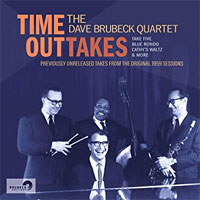
On one level, Time OutTakes is more of the same: alternate takes of the first five pieces from the original program, in the same order, plus a couple of tunes that didn’t make it to the record: “Watusi Jam,” the feature for Joe Morello’s drums “Take Five” was originally conceived to be (albeit in 6/4); and 1936’s “I’m in a Dancing Mood” in a fancy change-up arrangement Brubeck had recorded at Newport 1956 (though that version was truncated with a blunt splice). If anything, the alternate takes show how worked out everything was before tape rolled. And yet: Brubeck and Paul Desmond are real improvisers, and Time OutTakes provides fresh solos equally attentive to the contours of the written melodies. It lets us hear this very familiar session with fresh ears, a neat trick. The unheard takes are so strong, it may’ve been a coin flip picking the master, and you can do your own second-guessing. Brubeck’s heavy piano attack gives his improvised single-note lines a springy character that gets lost when he switches over to big, bright chords that wind up plodding along, the way he can behind a solo, too controlling. By that logic the new alternate “Cathy’s Waltz” beats the earlier version -- he stays airborne. Still, Brubeck’s big number, “Blue Rondo à la Turk” (with its 2+2+2+3 Turkish folk rhythm), is treated very much as a composition, despite its improvised blues interludes. The slightly slower tempo of the alternate makes it that much less frantic and ostentatious -- made me more attentive to Brubeck’s countermelody to Desmond’s lead line. The players can breathe a little more, but it’s still awfully repetitive. The big Broadway curtain-closer at the end of the form is silly in its excess, though the way that odd-meter stumble breaks into 4/4 swing and Desmond’s suave blues improvising anticipates umpteen pieces by Young Lions of the 1980s, where the head would be tricky but the seas for improvising easy to navigate. The best thing about Brubeck’s quartet is always Paul Desmond, whose sound and solos here wear very well six decades later -- as on the affecting “Strange Meadowlark” -- with his sweet/sour, vermouthy tone and imperturbable poise as improvising melodist (and spontaneous quoter of other tunes; he’s wittier and better at it than Brubeck). Gene Wright’s pliable bass keeps the rhythm aloft, where possible. Morello sounds great when interactive (as on “Cathy’s Waltz,” with brushes), but sometimes zones out into time-keeping autopilot. It’s a marvel how much better recorded jazz was in
1959 than 15 years later. (Columbia staff producer Teo Macero supervised.) We get a real
bass sound at a realistic volume level; just enough spread and sizzle to drums and
cymbals; a little distance in the alto sound, so it seems to pervade the room -- how
Desmond sounded best. Scott Petito cleaned up the tapes for release; Time OutTakes
is somehow warmer than but less reverby than Time Out, so this second helping has
better sound too. |