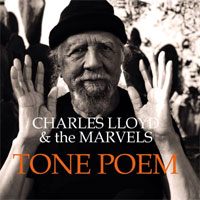
Charles Lloyd & the Marvels • Tone Poem
 harles Lloyd broke out
in the late 1960s as a modern jazz guy who clicked with the now generation -- his quartet
split bills with rock and blues bands at the Fillmores East and West. John Coltrane’s
influence was plain on Lloyd’s big-hearted, spiritual tenor sax and rapid scrambles,
but where Coltrane’s late music got progressively turbulent, Lloyd radiated sunny
optimism, giving a hippie-ish cast to the universal love ethic. (He also played flute, in
people’s-park-panhandler mode.) In the early ’70s, he’d record cross-overy
dates with rock guitarists (Dave Mason, John Cippolina, Jessie Ed Davis, Roger McGuinn)
and various Beach Boys. He dropped out a few years, until pianist Michel Pettruciani
coaxed him back on the road in the ’80s. Then came a long varied stint at ECM, a
label that knows something about laidback spiritual moods. At Blue Note nowadays, he
sometimes records with ad hoc foursome the Marvels, with two frequently paired guitarists,
Bill Frisell on electric and Greg Leisz on pedal steel. That band seemed designed to
broaden Lloyd’s appeal all over again, tapping countryish guest vocalists. Willie
Nelson and Norah Jones guested on their debut I Long to See You. Lucinda Williams
sang five tunes on the sequel Vanished Gardens. harles Lloyd broke out
in the late 1960s as a modern jazz guy who clicked with the now generation -- his quartet
split bills with rock and blues bands at the Fillmores East and West. John Coltrane’s
influence was plain on Lloyd’s big-hearted, spiritual tenor sax and rapid scrambles,
but where Coltrane’s late music got progressively turbulent, Lloyd radiated sunny
optimism, giving a hippie-ish cast to the universal love ethic. (He also played flute, in
people’s-park-panhandler mode.) In the early ’70s, he’d record cross-overy
dates with rock guitarists (Dave Mason, John Cippolina, Jessie Ed Davis, Roger McGuinn)
and various Beach Boys. He dropped out a few years, until pianist Michel Pettruciani
coaxed him back on the road in the ’80s. Then came a long varied stint at ECM, a
label that knows something about laidback spiritual moods. At Blue Note nowadays, he
sometimes records with ad hoc foursome the Marvels, with two frequently paired guitarists,
Bill Frisell on electric and Greg Leisz on pedal steel. That band seemed designed to
broaden Lloyd’s appeal all over again, tapping countryish guest vocalists. Willie
Nelson and Norah Jones guested on their debut I Long to See You. Lucinda Williams
sang five tunes on the sequel Vanished Gardens.
Most of Tone Poem comes from the same 2017 sessions for Vanished Gardens. No vocals, but the jazz populism and crossover aspirations remain: there’s a big-ballad cover of Leonard Cohen’s “Anthem.” Some of it goes down as easy as pablum, like Lloyd’s undulating tenor lick slinking around a two-chord vamp on the back half of the title track. His tenor tone is more insinuating than imposing; it’s not a big sound. Riffy flute tune “Dismal Swamp” with its chugging groove and little climbing-chord cadences could pass for pop-phase Herbie Mann. Five of nine tracks loiter near ten minutes, and the jamming can run too long, like a ’70s rock band padding out a double album. Still, there is rewarding playing here, chiefly on a trio of jazz classics: “Monk’s Mood” and Ornette Coleman’s ballad “Peace” and his barnyard hoedown “Ramblin’” -- the last of those being the place to start, where the Marvels’ country accents shine. To underscore its down-homeyness, Coleman’s version had Charlie Haden strumming “Old Joe Clark” on bass. Here that strain comes from the guitars. (Either version’s in the folky/unjazzy key of D major.) Frisell and Leisz go back a couple of decades, to when Frisell played mock-pedal-steel bends and swells. Now that he’s set aside his volume pedal, he still has his distinctive twang, but lets Leisz supply the Nashville markers. (Leisz can step out of that zone too; pedal steel’s woozy slides behind Reuben Rogers’s arco bass solo on the somber “Prayer,” recorded back in 2013 when the band was new, are closer to Chinese erhu than the Ryman Auditorium.) The pickers blend very well (and are well integrated in the mix by principal recordist Michael C. Ross -- Frisell center-left, Leisz center-right), and they improvise together at length; their interplay alone makes Tone Poem worth hearing. It’s mystifying that no pedal-steel player has made inroads in modern jazz the way Robert Randolph has in blues and R&B. Buddy Emmons among others long since demonstrated the right front-of-note jazz articulation. Susan Alcorn’s work in Mary Halvorson’s octet on 2016’s Away with You points up the possibilities. Marvels drummer Eric Harland has been recording with
Lloyd since 2004, and can swing (“Monk’s Mood”), shuffle
(“Ramblin’’), thump out a dry rockish beat (Lloyd oldie “Lady
Gabor”) or get conversationally propulsive (“Peace”) as required. Reuben
Rogers, who joined Lloyd and Harland in 2007, is often least present in the mix, maybe
because there’s already so much string activity on top, though the thickness of his
electric bass keeps him in the picture. Lloyd turned 80 in 2017, and there's one sign and
benefit of his respected elder status: the members of the Marvels sound more than happy to
be his jammy band. |