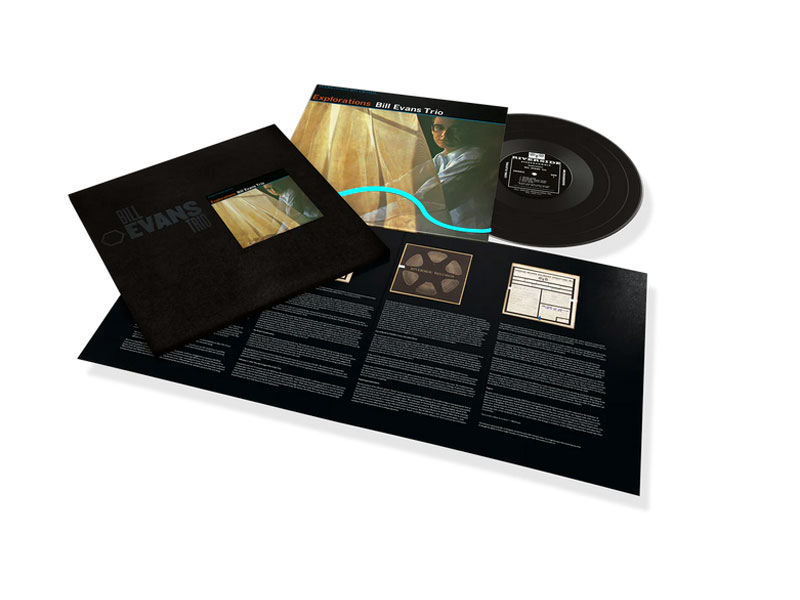
Bill Evans Trio • Explorations Riverside/Craft Recordings CR00825
What gave the trio, with its sparse recording history and just four releases, its great renown was the near telepathy of the playing. It may sound like a cliché, but Evans, LaFaro and Motian spoke with a single musical voice. They played intricate compositions and arrangements, often informed by classical music, and eschewed showy solos and improvisation for its own sake. In the process, they elevated the piano trio as an artistic form to a level not previously known. Call it “flow” or “being in the zone,” but they reached and maintained it. Listening to them can be akin to a religious experience. So many of their renditions are definitive, and even when other jazz greats cover the same tunes, my mind wanders to Evans, LaFaro and Motian. The playing on Explorations is in service to the tune at hand and the collective aesthetic aims of the musicians. On “Haunted Heart,” for instance, LaFaro and Evans sound like they are thinking in unison, LaFaro playing low, resonant notes that Evans can't reach on piano, which in turn dances gracefully above the bass. There's a standout, pensive “Nardis,” Miles Davis's well-known composition. Imagine a less-choppy Monk, more fluid in his rhythmic creations, and you have a sense of Evans's playing here. This is charming music, unshowy and seemingly simple, until you are drawn in by its understated invention. This is another Craft Recordings Small Batch One Step LP, a series that aims to produce the best records possible. While the top-line explanation of the One Step process comes from its name, that doesn't explain the full extent of why these records are so special. The standard process of record production begins with the music-containing groove cut into a lacquer-coated aluminum disc. The disc, called “the lacquer,” is metal plated, producing a resulting part called “the father.” This is again plated, creating another part, called “the mother,” which, like the lacquer, is a positive image of the music -- a disc that can actually be played. The mother is plated to produce the stamper from which the records are pressed. The process allows for multiple stampers to be created and therefore more records to be pressed (stampers wear out, after which they are not used).
In the One Step process, the first metal part produced from the plating of the lacquer is used to press the records, reducing the overall process by two steps and putting the records two steps closer to the lacquer and the master tape. That's all good; however, it also means that fewer copies of each record will be produced -- 2500 for Explorations, each pressed at RTI. One more important element: the vinyl used, Neotech’s VR900-D2 “super vinyl,” allows for greater groove detail to be captured and the resulting records to sound even better. It is also incredibly quiet, so the music isn't obscured by vinyl-induced noise. All of this, along with Bernie Grundman's remastering and cutting of the lacquers from the analog master tapes, works to create a highly detailed and musically involving version of Explorations. The piano's harmonics and overtones ring, the drums and cymbals sound airy and substantial, and the bass lines expand into the soundstage, the musicians occupying precise spots. This is a supremely natural-sounding LP, abundant with the unforced resolution for which analog playback is known. Craft's packaging is also noteworthy. A heavyweight, glossy, tip-on sleeve fits into a linen-covered, numbered slipcase. To remove the sleeve, and the record inside, you don't have to shake it free. You pull on an integral ribbon and it gracefully slides out. The insert includes an essay by writer and former music-marketing executive Syd Schwartz filled with useful information. It brings deep context to Explorations and the musicians who created it. This is a special album, one that has everything going
for it: performers, music, sound, and presentation. Evans led other great trios, but none
attained the near-mythic status of the one with LaFaro and Motian. They were the
proverbial flame that burned twice as bright and half as long. |



 he greatest trio
in jazz history -- pianist Bill Evans, bassist Scott LaFaro, and drummer Paul Motian --
recorded together only three times over the course of just two years. Explorations
was the second of four albums, released in early 1961, a year after Portrait in Jazz,
the trio's first album. They were the trio's only studio recordings. As most jazz hounds
know, Sunday at the Village Vanguard and Waltz for Debby, albums three
and four, were live recordings from the same session captured on June 25, 1961. Less than
two weeks later, Scott LaFaro died in a car accident, and the musical output of the
greatest trio in jazz history would be a mere four recordings.
he greatest trio
in jazz history -- pianist Bill Evans, bassist Scott LaFaro, and drummer Paul Motian --
recorded together only three times over the course of just two years. Explorations
was the second of four albums, released in early 1961, a year after Portrait in Jazz,
the trio's first album. They were the trio's only studio recordings. As most jazz hounds
know, Sunday at the Village Vanguard and Waltz for Debby, albums three
and four, were live recordings from the same session captured on June 25, 1961. Less than
two weeks later, Scott LaFaro died in a car accident, and the musical output of the
greatest trio in jazz history would be a mere four recordings.