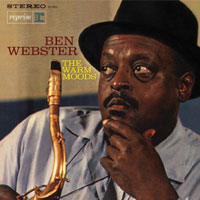
Ben Webster • The Warm Moods
 he melding of a jazz
ensemble with a string section has seldom produced albums of strong musical worth. Jazz
musicians are improvisational by nature, while a string section usually needs a written
score, so the two don't naturally mix. But every once in a while a jazz musician comes
along whose style lends itself to the added harmony of a string section, and Ben Webster
was one of them. His voice and style of play made him a prime candidate for an album with
strings. The Warm Moods was the result, and surprisingly it works -- and
works well. Webster’s way with a ballad, which is the bulk of the music on The
Warm Moods, meshes almost perfectly with the string backing conducted by Johnny
Rogers. Half of the tunes here use Webster, his rhythm section, and four cellos, while the
balance use Webster, the rhythm section, and cello, viola and two violins. The rhythm
section is made up of confirmed jazz musicians: Gene DiNovi or Donn Renner on piano, Dan
Bagley on bass and Frank Capp on drums. he melding of a jazz
ensemble with a string section has seldom produced albums of strong musical worth. Jazz
musicians are improvisational by nature, while a string section usually needs a written
score, so the two don't naturally mix. But every once in a while a jazz musician comes
along whose style lends itself to the added harmony of a string section, and Ben Webster
was one of them. His voice and style of play made him a prime candidate for an album with
strings. The Warm Moods was the result, and surprisingly it works -- and
works well. Webster’s way with a ballad, which is the bulk of the music on The
Warm Moods, meshes almost perfectly with the string backing conducted by Johnny
Rogers. Half of the tunes here use Webster, his rhythm section, and four cellos, while the
balance use Webster, the rhythm section, and cello, viola and two violins. The rhythm
section is made up of confirmed jazz musicians: Gene DiNovi or Donn Renner on piano, Dan
Bagley on bass and Frank Capp on drums.
What makes the jazz-strings combo work here is the light touch Rogers uses with the strings. He never tries to make them either the star or co-star of the album, but instead simply enhances Webster’s natural way with the music. While Webster does his improvisational thing with each number, Rogers uses the strings to lightly play the melody to contrast well with Webster’s playing. Webster floats over the backing, using his breathy, big tone to perform his musical choices as only he could. Listen to his renditions of "But Beautiful," "Stella By Starlight," "There’s No You," and "It Was So Beautiful" for proof that this is a Ben Webster album. If you’re a fan and have been put off by the thought of this music being degraded by the addition of strings as backing, your fears are groundless. The mix is handled in such a way as to put Webster at the center, with the strings adding a sense of color very different from the backing Webster normally received. While the music and performances are the star here, the sonics are not far behind. I’ve always respected Reprise albums (usually rock) for the solid, even outstanding sound. Here, I was pleasantly surprised by how good the original recording was, and how the remastering by Pure Pleasure has brought out the delights of this album. I own another reissue of this album [Discovery Records DS-818] that I enjoyed but never loved. This Pure Pleasure reissue smokes that pressing. Webster’s tenor sax has a full, powerful, and clean sound to it, set front and center and clearly in front of the rest of the musicians. If you listen, you can hear the breathy, reedy quality that so typified Webster’s sound. I hear air being blown past the reed and through the brass body of the saxophone by a powerful individual (and if you’ve ever seen pictures of Webster, you’ll understand why one of his nicknames was "The Brute" as he was a big man indeed.) All of the strings, whether the deeper sonorities of the cello, the lighter viola or the brighter violins, are all presented with a realistic sense of size and tone. It’s the rhythm section that is obscured here, shunted into the background. It's not that you can’t hear their contributions; it’s just that they aren’t as clearly rendered as Webster or the strings. But you can still follow each bass pluck, each drum snap, each piano note. I can see this album being played as the last choice
after a long day of listening or first thing on a Sunday morning -- it has that relaxing
vibe. But whenever you choose to listen, this is a reissue not to be missed. |