Wattson Audio • Madison Stereo Amplifier and Madison Streaming Digital-to-Analog Converter
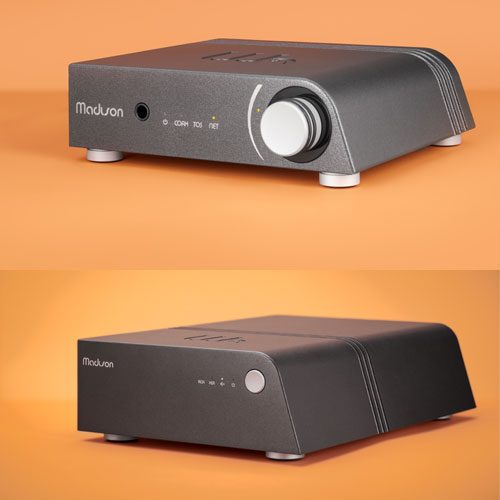
very time I move one of my 90-pound tube amplifiers or 60-pound integrated amplifiers into or out of my equipment rack, I am reminded that there are more sensible ways to assemble an audio system. That thought was very much in mind when I carried the Madison amplifier (13 1/4 pounds) under one arm and the Madison streamer (under 2 1/2 pounds) in my hand. Photos sent to a few audio friends drew comments such as, “They’re tiny,” and “They’re kind of cute.”
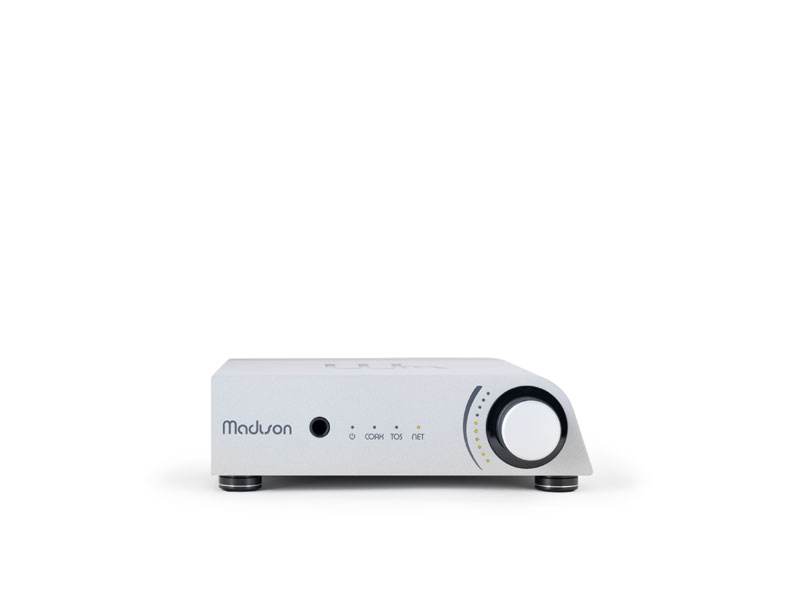
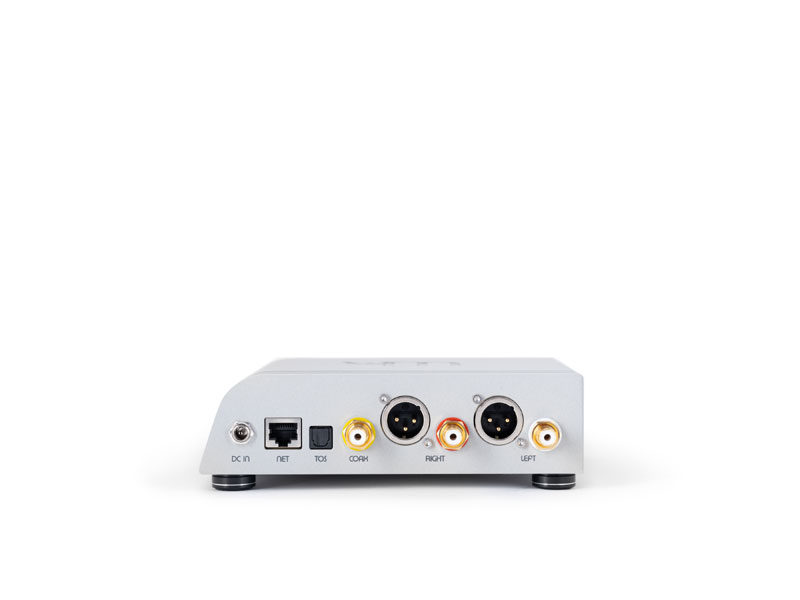
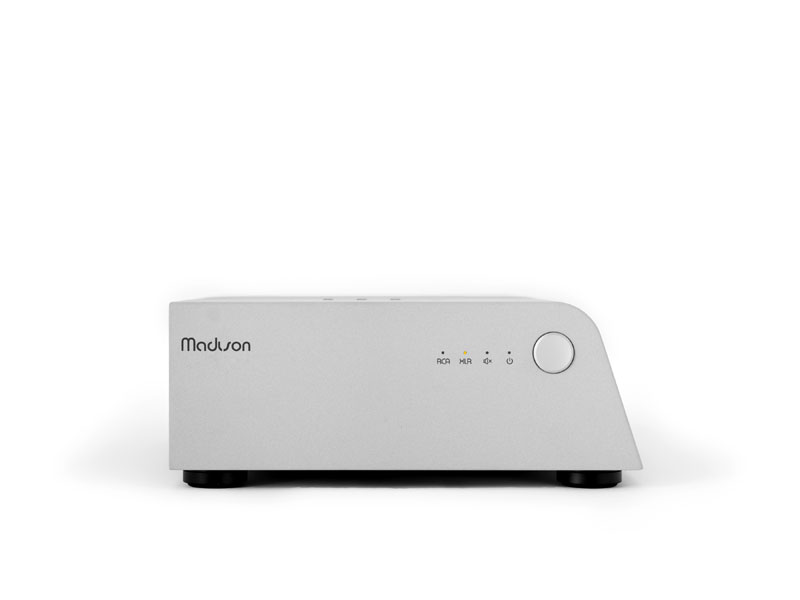
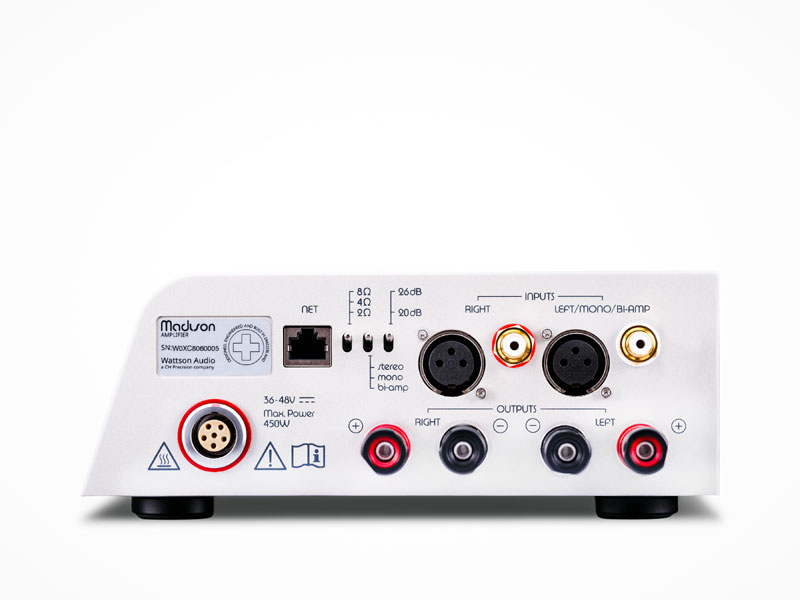
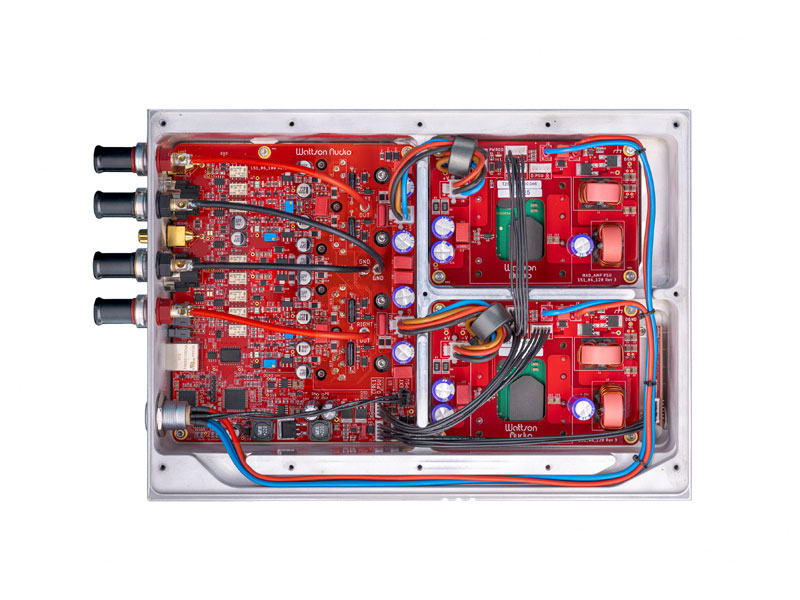
It's easy to assume that this small Swiss duo is aimed more at lifestyle use than serious audio, or that its compact size comes at the expense of performance. That assumption would be mistaken. Wattson Audio was founded after years of providing design consultation to high-end audio manufacturers, with a particular focus on music streaming. Wattson later developed its own digital products that, according to the company, “offer authentic high-end sound at an attainable price.” Following CH Precision's acquisition of Wattson, Wattson now benefits from CH Precision’s circuit-design expertise and manufacturing resources. The Madison amplifier joins the Madison streamer as Wattson’s top-tier electronics. Despite their modest weight, both components have chassis machined from solid aluminum and finished in a sandblasted texture. The Madison streamer combines a network streamer, DAC, and digital preamplifier in a compact chassis. Inputs include Ethernet, coaxial S/PDIF, and TosLink; USB connectivity is not provided. When I asked Wattson’s chief engineer, Alexandre Lavanchy, about this omission, he explained that adding USB would introduce additional complexity and electrical noise, which ran counter to Wattson’s design priorities. For similar reasons, the streamer also omits touchscreen control, along with I²S and HDMI connectivity. Analog outputs are RCA and balanced XLR, and both may be used simultaneously. The front panel includes LEDs for standby and input selection (Network, TosLink, or S/PDIF). Pressing the volume knob cycles through inputs, while an arc of LEDs indicates the volume level. The continuously variable knob controls a 100-step digital volume circuit developed in collaboration with CH Precision specifically for the Madison platform. A 64-bit digital attenuator that operates in 0.5dB steps, verified to within ±0.1dB, it was designed to minimize truncation and rounding errors so linearity and low-level integrity remain intact. A single 1/4" headphone jack completes the front panel. Power is supplied by an external 5V supply connected via a short umbilical. Via its network input, the streamer supports PCM up to 32 bits/384kHz and DSD256. A Texas Instruments Sitara processor handles incoming data, which is upsampled to 384kHz. Further processing is performed by a SHARC DSP using cubic-spline interpolation. Digital-to-analog conversion is handled by twin Wolfson WM8742 DACs in a dual-mono configuration. The Madison amplifier draws on circuit concepts used in CH Precision’s reference amplifiers. It is a low-feedback class-AB design employing high-power bipolar output devices. Rated output is 50Wpc into 8 ohms, 75Wpc into 4 ohms, and 120Wpc into 2 ohms. Primary power is supplied by an external 36V, 350-watt DC supply. Inside the amplifier chassis are two isolated DC-to-DC converters that generate the required voltage rails. Wattson reports that these converters operate near 300kHz and are critical to the amplifier’s sound. The combination of an external linear supply and internal high-frequency conversion allows the amplifier to handle demanding loudspeaker loads. A single front-panel button brings the amplifier out of standby, mutes the output, or selects between RCA and XLR inputs. The amplifier remembers the last input used. After 40 minutes without an input signal, the amplifier automatically returns to standby. The rear panel includes RCA and XLR inputs, five-way binding posts, and three configuration switches. A gain selector allows adjustment between 20dB and 26dB to facilitate matching with external preamplifiers. An impedance selector offers 8-, 4-, and 2-ohm settings. A third switch selects stereo, biamp (for vertical biamping), or mono operation, the latter routing the full power supply to a single channel. An Ethernet port is included for possible firmware updates, although none are currently available. Setup was straightforward -- any owner should have music playing within ten minutes. The first step is to download Wattson Music, a free app necessary to access Qobuz or Tidal, Radio, or any network servers you are currently using. Qobuz Connect, Tidal Connect, Roon and Audirvana’s “Plays with Audirvana” streaming protocols are also supported. The streamer requires an Ethernet connection, and it found my network almost immediately. Once I had entered my user name and password for Qobuz, the setup was complete. Volume control within the app is handled by a slider. While responsive, it is sensitive enough that occasional abrupt level changes are possible. The app also allows remote input selection and provides the option to disable volume control when using the streamer as a DAC only. Additional app functions include LED brightness adjustment, input renaming, and a simple EQ offering three presets: Free Field, Near a Wall, or In a Corner. These settings may be applied independently to the left and right channels. I also used Qobuz Connect, which functioned reliably. I found that Wattson Music provided finer volume control, so I often used both apps simultaneously on an iPad -- Qobuz Connect for browsing and Wattson Music for volume adjustment. I also used AirPlay. While listenable, it sounded more forward and offered less low-level resolution than the other streaming options. Wattson itself notes that alternative protocols better preserve high-resolution audio quality. For casual use or guest playback, however, AirPlay is perfectly serviceable.
ithin a few minutes of initial listening, the Madisons (for clarity, I will refer to the amplifier and streamer together from this point forward) established themselves as refined, low-noise electronics with precise imaging. Soundstage width and depth were immediately apparent, aided by a notably quiet background. Resolution proved to be a consistent strength, particularly on recordings rich in spatial and textural detail. While more powerful and costly systems can deliver greater ultimate dynamic impact, the Madisons provided sufficient drive and control for a wide range of music, including rock, electronic, and large-scale orchestral works. Instrumental tone and timing remained recurring strengths throughout the review period. Low-level resolution was especially apparent on Reveries, recorded by Eiji Oue and the Minnesota Orchestra [Reference Recordings RR-99, Qobuz 24 bits/176kHz]. This is a recording that sounds agreeable on most competent systems but rewards electronics capable of great nuance. In Grieg’s “Solveig’s Song,” the Madisons preserved the orchestra’s warm, blended string tone while revealing subtle variations in bow pressure among individual players. The effect recalled the perspective of sitting close to the violin section, where the ensemble remains cohesive yet individual character remains audible. One violinist consistently stood out as slightly brighter than the surrounding section. Another revealing track from the same album was the “Intermezzo from The Jewels of the Madonna.” The opening flute note can sound vague or synthetic through less capable digital sources. During a group listening session, I briefly substituted a modestly priced DAC into the system; for a moment, the flute’s identity was unclear until vibrato was introduced. Reinstalling the Madison streamer restored tonal specificity immediately. One musician present remarked that the Wattson electronics established the flute’s character from the outset, without ambiguity. The Madisons also handled this passage convincingly when driving my Falcon Gold LS3/5a loudspeakers. The Madisons’ low noise floor and precise timing made the mechanics of acoustic sound production unusually easy to follow. This quality is sometimes described as an instrument’s “action.” A particularly effective demonstration is Kham Meslien’s “Ta confiance,” from Fantômes…Futurs [Heavenly Sweetness HS234, Qobuz 24 bits/48kHz]. The track opens with a closely miked double bass. Through the Madisons, the initial scrape of finger against string was clearly audible, followed by the resonant response of the instrument’s body. The slight temporal delay between string excitation and body resonance -- a defining characteristic of the instrument -- was rendered with convincing realism. An even more pronounced example of timing and instrumental action was found in Kuniko’s J.S. Bach: Solo Works for Marimba [Linn Records CKD585, Qobuz 24 bits/192kHz]. In the Bach Cello Suite arrangements, the Madisons clearly differentiated the initial mallet impact, the tonal character of the bar, and the delayed response of the resonators beneath. The increasing time lag in the lower registers was reproduced convincingly. The resulting presentation closely resembled the live marimba sound I hear regularly during wind-ensemble rehearsals. Linn’s recording quality is exemplary, and the Madisons allowed it to be fully realized. The streamer’s headphone output retained much of the system’s character when listening without loudspeakers. Power output is limited, and Wattson recommends low-impedance headphones. With my 12-ohm Sony MDR-R1, the streamer delivered a spacious and engaging presentation, particularly on the Minnesota Orchestra recordings. Switching to Audio-Technica W1000X headphones (42 ohms) produced ample drive and energy. Trentemøller’s “Chameleon,” from The Last Resort [Poker Flat Recordings PFRCD 18, Qobuz 16 bits/44.1kHz), generated substantial low-frequency impact without sounding loose or overblown. For most of the review period, I used the Madisons with the Wattson Music app, as it consistently produced the most engaging sound in my system with the Falcon Gold LS3/5a loudspeakers. Qobuz Connect sounded smoother overall but exhibited slightly softer transient attacks and reduced treble extension. Returning to Wattson Music restored a livelier top end and firmer bass definition. While I preferred Qobuz’s browsing interface, I ultimately favored Wattson Music for critical listening. Alexandre Lavanchy explained that Wattson Music communicates via UPnP/DLNA, with audio-stream handling managed entirely by Wattson’s own software to ensure bit-perfect transmission. By contrast, Qobuz Connect and Tidal Connect rely on proprietary protocols. Lavanchy could not definitively attribute the sonic differences I observed to this distinction, but, in practice, variations among streaming platforms were readily audible through the Madisons. One reason I selected the Falcon LS3/5a Gold Edition speakers for much of the review was the expectation that the Madisons would be well suited to smaller rooms or nearfield listening. While I also tried the system with my vintage Altec Valencias, those speakers clearly favor tube amplification. The Falcons, by contrast, proved to be an excellent match. They filled my listening room with a soundstage far larger than their size would suggest. On several occasions, visiting audiophiles expressed surprise at the scale, coherence, and bass control of the Wattson/Falcon pairing. Bass was quick and tuneful, with appropriate weight and no excess bloom, while treble was extended and clean. Another unexpected pairing was with my Magnepan LRS loudspeakers. Given their low sensitivity, I did not expect the Madison’s 50 watts per channel to be sufficient. In practice, the amplifier drove the LRS's without difficulty. Soundstage width was expansive, center imaging was stable, and overall tonal balance was convincing. While I have rarely been able to reproduce the impact of Magnepan’s 2019 AXPONA demonstration in my own room, the Madisons came closer than expected. I enjoyed this combination enough to return the LRS's to the listening room on several occasions. Near the end of the review period, I received Wilson Audio’s Sabrina V loudspeakers and used the Madisons in their 2-ohm output setting during break-in. Even with these demanding speakers, the Madison amplifier provided sufficient power for my listening levels. The amplifier’s clarity, control, and tonal balance were further revealed by the Wilsons’ resolving nature. I will discuss this pairing in greater detail in a separate review of the Sabrina V. Although the Madison streamer and amplifier were primarily auditioned as a pair, I also evaluated each component independently. Compared with my BorderPatrol DAC, the Madison Streamer offered greater resolution and more precise image placement. Bass was tighter, though not necessarily deeper, while the BorderPatrol produced a warmer, fuller low end. The BorderPatrol’s prominent second-harmonic character imparted a lush presentation, whereas the Madison streamer sounded cleaner and more neutral. While I generally preferred the Madison’s accuracy, I continued to enjoy the BorderPatrol’s overtly musical voicing. In other systems, the Madison streamer compared favorably with significantly more expensive DACs. Against a tubed-output Lampizator DAC, the Madison emphasized precision and rhythmic drive, while the Lampizator offered greater tonal richness. Both presentations were compelling in different ways. In another system, the Madison streamer clearly outperformed a Denafrips DAC paired with its matching DDC reclocker, offering better focus, lower perceived noise, and more precise timing. The Madison amplifier remained consistent when paired with different preamplifiers, including models from Herron Audio and BorderPatrol. Both tube preamps added a touch of harmonic richness and slightly softer highs, but the amplifier retained its core character: articulate bass, a clear midrange, and good dynamic contrast. The amplifier also paired well with DeVore Fidelity O/93 loudspeakers, producing an energetic and engaging presentation with taut, extended bass.
he Madison streamer and amplifier deliver a level of sonic refinement that belies their modest size and weight. Throughout the review period, they consistently revealed subtle details in familiar recordings while maintaining tonal balance and rhythmic coherence. It seemed there was always something new to be heard in familiar tracks and something “just right” about their tonality and rhythmic precision. Several experienced listeners independently expressed surprise at how complete and satisfying the Madisons sounded. Compact, thoughtfully engineered, and musically
persuasive, the Madisons represent a compelling entry in today’s high-end-audio
landscape.
|
||||||||||||||||||