Shunyata Research • Omega-X Interconnects and Speaker Cables
uring my thirty years of writing about audio equipment and music, I have watched a number of audio companies come into being, thrive, struggle, and fail. Among the select group of thrivers is Shunyata Research. Its founding, the development of its unique technology, and its position in the audio industry comprise one of the real success stories of the past thirty years. During its earliest days, Shunyata produced only power cords, then added power conditioners to its product lineup. Finally, interconnects, speaker cables, and digital cables, were added, all of which Shunyata idiosyncratically called “signal cables,” perhaps only to differentiate them from their products that carried AC. Shunyata also branched out with products designed specifically for recording studios and medical facilities -- more proof of the efficacy of its technology.
While there have always been top-of-the-line Shunyata Research cables, their pricing relative to the rest of the market was decidedly low -- too low, in fact, according to many dealers and even some press. Caelin Gabriel surely heard all of this, but for many years the price of his best cables barely crept upward. There was a reason for this. A barrier just as significant in the way Shunyata built and evolved its product line is how the company's signal cables built on previous models. It was common for a new mid-level Shunyata cable to eclipse the previous existing top of the line, disrupting the sense of order consumers need in order to make buying decisions and causing product pricing to be especially tricky. This all began to change in the mid-2010s, when Shunyata introduced a lineup of technologies Caelin Gabriel had spent years developing and refining to supercharge his line of signal cables. Then, in late 2020, came Omega, Shunyata's true flagship line of interconnects, speaker cables, digital cables, and phono cables. Omega's pricing was decidedly upmarket, more in line with that of other manufacturers' top products. The performance was based on the full slate of Shunyata's technologies and design features. At the heart of them all was an overarching commitment to passive approaches that address noise in various ways and do nothing to the musical signal. The new Omega-X interconnects use Shunyata’s
single-crystal OHNO silver conductors, which are created via a special casting process to
form a continuous crystalline structure. I've heard of and used audio cables that have
single-crystal copper conductors, including some from Shunyata Research, but this is a
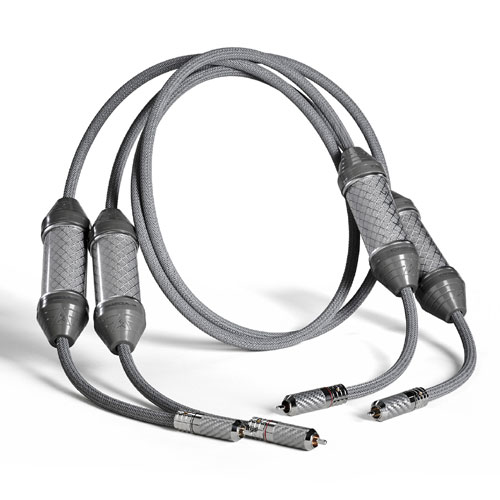
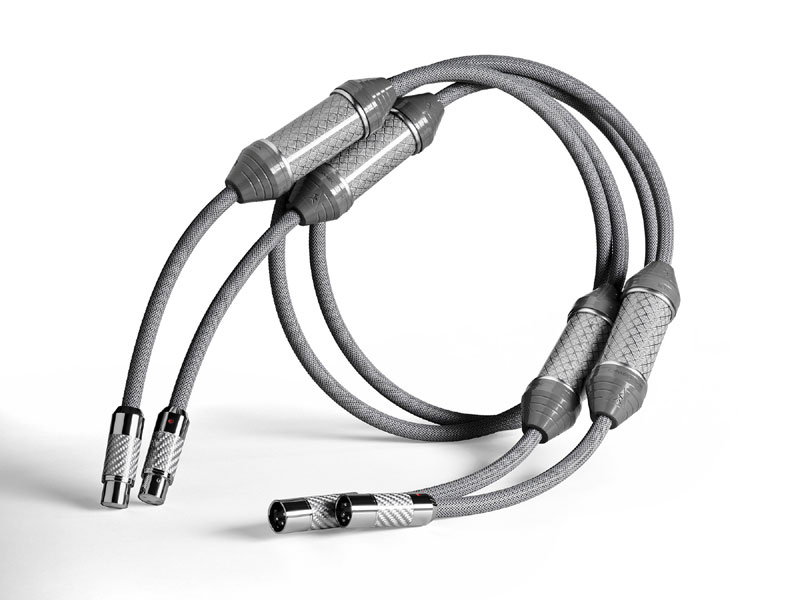
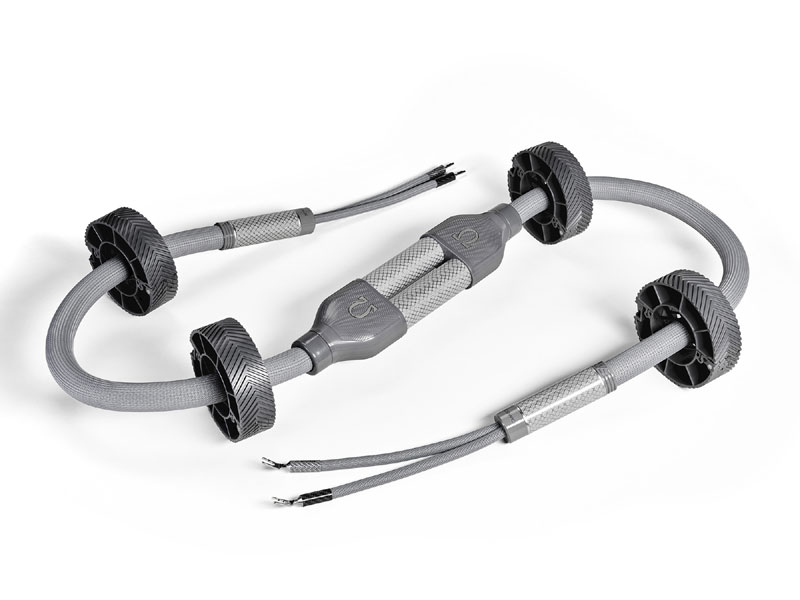
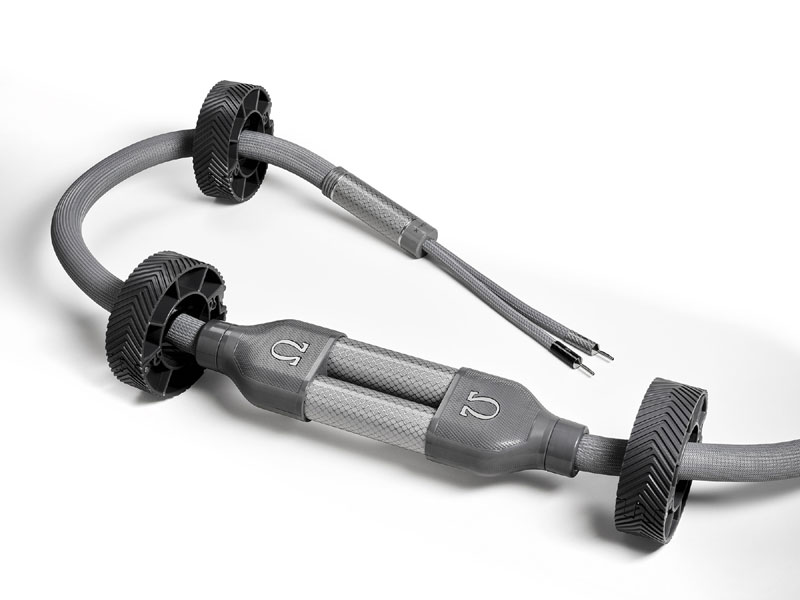
first for me with silver. The conductor benefits from Shunyata's Like its predecessor, Omega-X interconnects and speaker cables use Shunyata's Transverse Axial Polarizer, TAPc for short. This is a patent-pending device that modifies the electromagnetic field surrounding each cable. The original TAP used gold-plated copper honeycomb discs encased in a tube and positioned along each interconnect, looking sort of like the meal a snake just ate. TAPc uses far more complex, dual-concentric molded rings. Earlier Shunyata interconnects had a standard TAP near the upstream end, but Omega-X has TAPc's near both ends. Shunyata compares the sonic effect of TAPc to being like polarized sunglasses, reducing glare by altering the electromagnetic field's deleterious effect on the signal. Other claimed sonic effects are a lower noise floor, greater low-level resolution, improved timing and coherence, and reduced effects of electromagnetic interference. According to Shunyata, TAPc is a central to the performance of its X-generation products. Omega-X speaker cables use Shunyata's VTX-Ag conductors, which combine a silver core with an outer concentric ring of pure copper. The sonic intent is to combine silver’s speed and resolution with copper’s tonal density, body, and authority. The speaker cables come with another proprietary Shunyata technology: HARP, which eliminates micro-distortions related to striations -- vibrational energy generated by the pulsing signal. The first Omega speaker cables used two HARP modules (they look like tiny circuit boards), but Omega-X uses four that surround and protect additional TAPc technology and have been modified and improved, doubling the overall effect. Shunyata also upgraded the speaker cables with their own carbon-fiber end pieces that surround and protect additional TAPc technology and lower the vibrational Q of the cables. Finally, the cables come standard with Shunyata's Möbius suspension system -- a series of snap-on rings that not only keep the speaker cables off the floor, where they can be affected by static electricity, but also cradle them in silicone bands that provide isolation from floor- and airborne-vibrational energy in three dimensions. They are unique and look almost space age, and I'm sure it was no small task to design and manufacture them. Both the Omega-X interconnects and speaker cables use the highest quality connectors and dielectrics. The connectors look like jewelry -- and so they are, sort of. They are platinum plated over pure Tellurium copper, and not for looks. About them Shunyata says, they “deliver exceptional fidelity and tonal purity, offering a smooth, natural presentation with enhanced resolution”... while “clarity, contrast, and dimensionality are preserved across the full dynamic range of the system.” The cables' fluorocarbon dielectric's very low absorption, high strength and high heat resistance reduce dynamic compression and improve low-level resolution and clarity. All Shunyata cables also go through the company's proprietary Kinetic Phase Inversion Process (KPIP v2), which significantly reduces the settling and break-in processes typical with many high-end cables. Years ago, Shunyata advocated cryogenic treatment of its cables, but the development of KPIP ended that. Shunyata says that cables treated with KPIP v2 are more transparent, stable and free of distortion than cables that are pre-conditioned with cryogenics or broken in by playback alone or other burn-in methods. The effects of KPIP v2 are permanent, and treatment means that new Shunyata cables will offer nearly full performance when you receive them. However, Shunyata says they will continue to improve over 100-150 hours of use, especially the larger current-carrying speaker cables and power cords. Another detail that matters is the elimination of soldering from the speaker cables, which use a pneumatic-compression cold-weld process that creates a mechanically bonded connection between the conductor and the connector. This, according to Shunyata, avoids the use of third-party metals that they've found add distortions to the sound. It also ensures that the sonic signature of solder is entirely eliminated. Solder has a sonic signature? I can't say that I've done any tests, but there are people whose ears I trust, including Ken Stevens of Convergent Audio Technology, who say it does. In high-end audio, everything matters, and if you consider that solder is used throughout electronics and speakers, then its having a sonic signature seems plausible at the very least.All of what I offer above is a mere summary of the various technologies that go into the Omega-X interconnects and speaker cables. The conclusion is that there is nothing stock, standard or perfunctory here. Having spent time talking to Caelin Gabriel over the years, I can say that he's relentless about what he does and a true audio pioneer in so many ways. Omega-X is his greatest “signal cable” expression. I used the Omega-X interconnects and speaker cables with a diverse lot of analog and digital sources, electronics and speakers, most new but some older. I've written in the past about the perils and pitfalls of reviewing audio cables. To summarize, on the one hand, I don't want to change my regimen of critical listening just because the products I'm evaluating are interconnects and speaker cables, not speakers or amplifiers. Sound is sound, after all. I've found, however, that I need to take a careful, repeatable approach to reviewing audio cables, because I almost never evaluate only interconnects or speaker cables but rather an entire system's worth of products that includes both of these and sometimes digital cables and power cords. The variables in any audio system -- the number of components -- can be numerous, and they have to be accounted for if you want to hear, really hear, what any new product adds to or subtracts from an audio system. This is especially true for those of us in the reviewing trade, because of the ongoing treadmill of equipment coming to and going from our systems. Cables connect it all, so there are more of them in use and therefore more opportunities to affect the sonic end product. So I don't simply add all of the cables at once, and I don't rely solely on a piecemeal approach either. I do both -- adding single cables until the entire system is wired, then return to an established reference. After my ears have become acclimated, I then add the entire set of cables. And then I repeat. In the past, I've likened audio cables to a painter's paint and canvas, because they define the confines of the view and the means of conveying it. Perhaps a better analog is that the individual components are like the weather on any given day, and the cables are the overall climate. One is a snapshot and the other is the prevailing condition. No matter which analogy seems most relevant, it's only through all of the swapping that I can bring my various observations together and create an accurate description of the sound.
nce I began initial listening with the Omega-X cables, I started to think about how audio cables have evolved since the mid-1980s, when the product segment was launched and began to grow. Back then, the use of copper for interconnects and speaker cables was almost a constant and silver was a rarity. “High-purity” was the phrase most often used to describe the conductors; “six-nines” and especially “single-crystal” were still years away. Pricing was all over the spectrum, but the rare cables that used silver, because of its slightly increased conductivity over copper, were esoteric and expensive, and they offered a sound that was different from the copper cables that dominated the market. They were most often used in systems whose sound needed a shot in the arm, because silver's sonic signature emphasized the leading edge of notes, along with speed and space, to the detriment of harmonic and tonal neutrality as well as musical wholeness. This copper-silver dichotomy pretty much persisted throughout the 1990s, and still exists today: you can often get a sense of what interconnects or speaker cables will sound like simply by knowing the composition of their conductors. I would argue this is due to a simple and rudimentary belief about audio cables in general: that the wire itself is what matters most. Omega-X represents a totally different approach -- less about the conventional “our wire is better than yours” model and more concerned with controlling all variables surrounding that wire. Shunyata combines high-purity, carefully crafted conductors with passive electromagnetic-field control (TAPc), speaker-cable current-resonance control (HARP), low-absorption dielectric materials, platinum-plated connectors, extensive metal conditioning, and a mechanical environmental-control system (Möbius). The resulting cable system aims to preserve the signal while minimizing noise, resonance, and dielectric-related artifacts rather than trying to voice with wire and create some sort of tone control or equalizer. This comprehensive approach is just what audiophiles expect, but don't always get, from top-of-the-line offerings at this price level. During the past twenty-plus years, I've used and written about multiple sets of Shunyata Research interconnects and speaker cables, but all of this experience didn't prepare me for what I heard from the Omega-X. These are the most transparent, downright invisible cables I've heard. They convey music with the full tonal and spatial palette, midrange precision and presence, the tiniest dynamic shifts, and center-of-the-earth bass. Such sonic attributes don't convey the full array and depth of Omega-X's positives, however, as they bring out the fullest performance of an audio system. They are the most complete audio cables I've heard, seemingly delivering all of the sonic abilities of the components they connect. Related to this is perhaps their greatest feat: their ability to pull together the various electronics and transducers into a compelling sonic whole. I noticed right off that with the Omega-X cables in my system that transients had more snap, along with a more colorful tonal character and meaty body to every note. The sound was vivid in a new and exciting way. However, this came not as a byproduct of emphasizing the leading edge of notes; it would be simplistic to characterize Omega-X as merely having no trace of silver's thin, wiry, and grayish sonic signature. Instead, the Omega-X cables heightened the contrast between transients and the music from which they emerged, sounding unforced and lively but also present and powerful. With disparate recordings such as Muddy Waters' electrified Folk Singer [Mobile Fidelity UDCD592] and Glenn Gould's …And Serenity [Sony Classical/Legacy SK 90538], a compilation of solo-piano performances, the Omega-X cables presented the music with great ease, gobs of detail and space, and tremendous presence. The music and the recording venues were in the room, a deft mixture of “they are here” and “you are there” sound. Strings, brass and especially cymbals had a delicate, shimmering quality that revealed the sophistication of the Omega-X's treble, and the midrange rendered voices with this same quality -- not a colored sweetness or fullness but a mixture of fine detail and minute dynamic gradations, along with utter tonal neutrality. Drummer Peter Erskine's Live in Italy CD [Fuzzy Music PEPCD28] is a beautifully resolved recording, with piano overtones that seem to decay forever and a panoramic soundstage. Omega-X's no-stone-unturned approach to noise elimination pays huge dividends here, putting the sound of this CD into SACD territory. The same goes for the Modern Jazz Quartet's No Sun in Venice [Atlantic 1284-2]. Here, though, there is some natural reverberation from the space in which the recording was made, especially with Milt Jackson's vibes. The Omega-X cables presented it all as an unpretentious and continuous soundfield, one with sonic characteristics so well rendered that they were impossible to ignore. Playing different versions of the same recording often reveals more about the hardware than the software, letting you know how well it is able to capture and convey differences in the mastering (if any exist) and especially in formats. I have four different copies of the Beach Boys' Pet Sounds LP -- one in true stereo [Capitol Records 72435-21241-1-4], one in faux stereo [Capitol Records DT 2458], and two in mono [Warner Bros. 2MS 2083, Capitol Records/Interscope Records DSS 6], which is how the LP was released in 1966. I reviewed the last one, which is one of the super-special One Step releases from Interscope's Definitive Sound Series. The others were various mass-produced versions. When I was doing the listening for my review, I honestly don't think I could have discerned and described the differences as well without the Omega-X cables in my system -- everything from a dreadful phasey quality of the Capitol Duophonic rechanneled stereo version, to the incredible inner detail from the recording process -- a big part of Pet Sounds -- of the Interscope LP, to the different and totally valid takes of the other two pressings. Analog really came alive here and with all of the LPs I listened to with the Omega-X cables in my system. I will give a great deal of the praise here to Caelin Gabriel's comprehensive suite of noise-killing technologies. The tiny analog signal, which is boosted by a huge amount of gain, is more prone to distortion than digital, but when it's right, it can still demonstrate that it reaches the highest sonic plateau. At all times I had the overwhelming feeling that the Omega-X cables were revealing everything my analog rig was capable of. The improvement was that obvious and, more importantly, that musically significant.Another good though different example of this occurred a couple of months ago, when I bought a new Dynavector cartridge, one to use as a “daily driver” for first listens to the LPs I write about. The 20X2A-L is a terrific cartridge -- highly resolving and, more than this, a great deal of fun to listen with. The Omega-X cables not only showed my other Dynavector cartridges, the XV-1s and XV-1t, as more revealing than the far-less-expensive 20X2A-L, they also didn't gloss over the 20X2A-L's slightly more narrow soundstage and reduced bass power. However, that sense of fun I mentioned was a product of the cartridge fitting into the fabric of the much more expensive system that surrounded it, and it made me question with every listen whether it's necessary to spend more than the roughly $1500 price of the 20X2A-L. Again, I think this had to do with the wholeness of the Omega-X's performance, as though every sonic element was present and in proper proportion, presented through the proverbial open sonic window. A while ago, I devised a way of describing the sound of a component in a more universal manner, one that readers could use to hear some of the things I write about. I do this by identifying a recording or two whose sound reminds me of that component. It's imperfect, I admit -- audio equipment and the music it is designed to reproduce are about as similar as chick peas and chicken. But they are intimately related, and any way of answering the question “What does it sound like?” is valuable in my mind, even if it is imperfect. As I listened with the Omega-X cable system, my mind wandered to not one recording but the output of an entire label: ECM, which almost without fail has provided extraordinary sound -- from its earliest releases in the late 1960s to the current day. I have more than a hundred ECM CDs and LPs, and each is a treat to hear, because of the diverse and often challenging music, which falls loosely into the category of modern jazz, and great sound. As I observed in a recent review of three ECM LPs, the label's sound is defined by “a neutral . . . tonal balance; a spacious and airy soundstage; finely drawn dynamic variations; and abundant low-level resolution”; also, “abundant inner detail, natural musical textures, a spacious soundstage, and finely resolved microdynamics.” Add “the unique and compelling resolution of tonal shifts and gripping low frequencies,” and the resulting description nicely summarizes what I heard from Omega-X.
often speculate in my reviews about who the potential buyers are for the products I cover, but that's not necessary with Omega-X, because the answer is obvious: someone assembling a no-compromise state-of-the-art audio system with the financial resources to do the job right. However, money on its own has never undone an audio misstep. It is also the case that the choice of audio products is a personal one, and whether the chosen sources, electronics, speakers and cables come together to create an exalted system is not assured. Needless to say, consumers must choose wisely. Potential Omega-X owner will have particular wants and needs, especially with respect to the musical signal and the abhorrence of any noise that distorts it. Given this, two brands with similar aims immediately come to mind: CH Precision and Wilson Audio. Both are preoccupied with not just reducing noise in their products but eliminating it. I have experience with both brands, and while they were not part of my system with the Omega-X cables, I wish they had been. I suspect the resulting sound would have been something special -- a highlight of my nearly thirty years of reviewing audio equipment. Thus was the spell the Omega-X interconnects and speaker cables cast. Listening with
them was something I leaned into throughout the review process, instead of simply sitting
back and observing. They were truly engaging, producing the kind of sound for which you
are not a mere sonic spectator. Omega-X extends much of the technology of Shunyata's best
power products to the company's signal cables. It is a true reference and end point for
listeners with systems that demand the absolute in terms of sonic realism, and the fullest
expression of Caelin Gabriel's thinking here and now.
|
||||||||||||||||


 (pronounced
“Zi-Tron”) technology developed over fifteen years ago. A second conductor
carries a signal derived from the main conductor, and the fields generated by the two of
them cancel each other, neutralizing the electric field generated within the cable's
dielectric. Shunyata touts the effectiveness of this patented cable design (US patent,
US8912436B2; China patent, ZL2011800473442,; German patent, 601011046558.9; UK patent,
2622612) to “preserve the integrity of the source signal, even when using very long
runs of cable,” a point the company emphasized at various audio shows, where they ran
demonstrations of the technology and its measureable effect.
(pronounced
“Zi-Tron”) technology developed over fifteen years ago. A second conductor
carries a signal derived from the main conductor, and the fields generated by the two of
them cancel each other, neutralizing the electric field generated within the cable's
dielectric. Shunyata touts the effectiveness of this patented cable design (US patent,
US8912436B2; China patent, ZL2011800473442,; German patent, 601011046558.9; UK patent,
2622612) to “preserve the integrity of the source signal, even when using very long
runs of cable,” a point the company emphasized at various audio shows, where they ran
demonstrations of the technology and its measureable effect.

