Octave Audio • V 70 SE Integrated Amplifier
he Octave Phono EQ.2, which I reviewed for The Audio Beat last year, could easily be carried in one hand and placed on the equipment rack with no problems. Not so the Octave V 70 SE integrated amplifier under review here. The FedEx courier used his handcart to drop it off on our porch, and I enlisted help to schlep it into the house and assist in unpacking. The sturdy, double-boxed shipping container weighed over fifty pounds and was rather unwieldy, requiring careful handling.
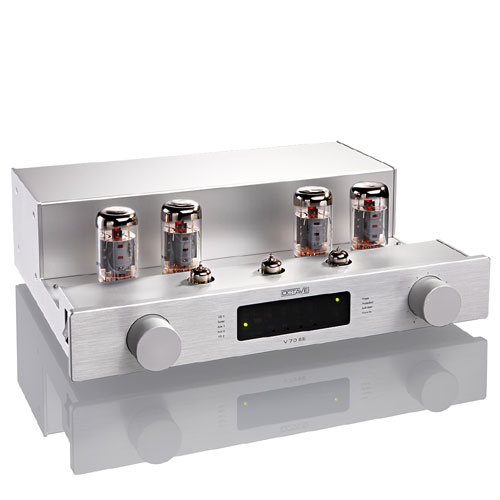
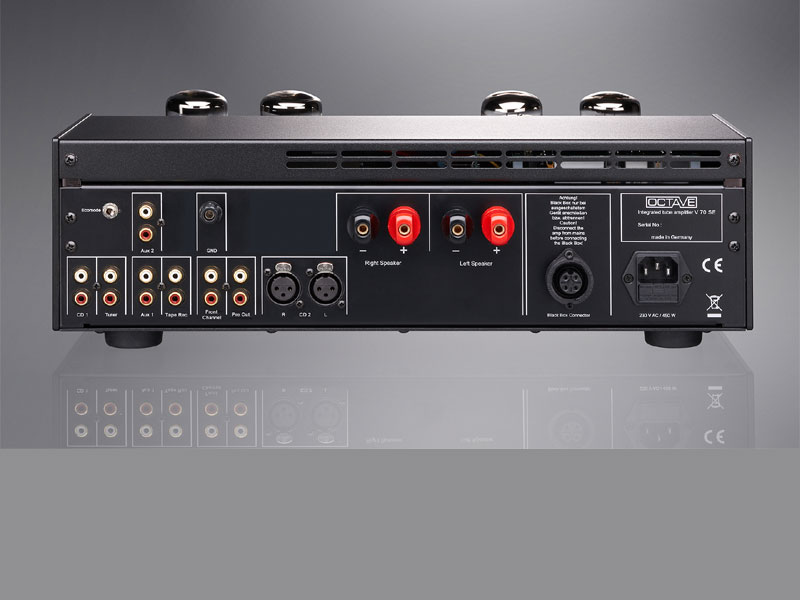
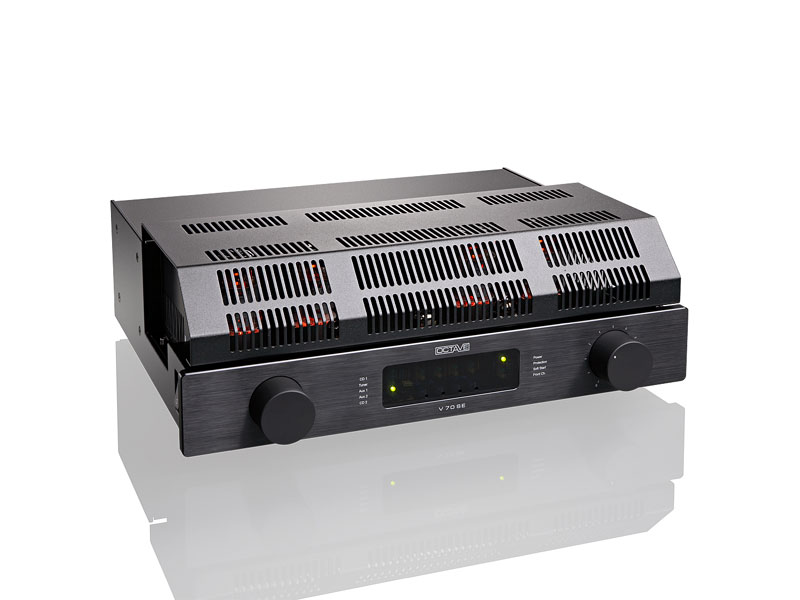
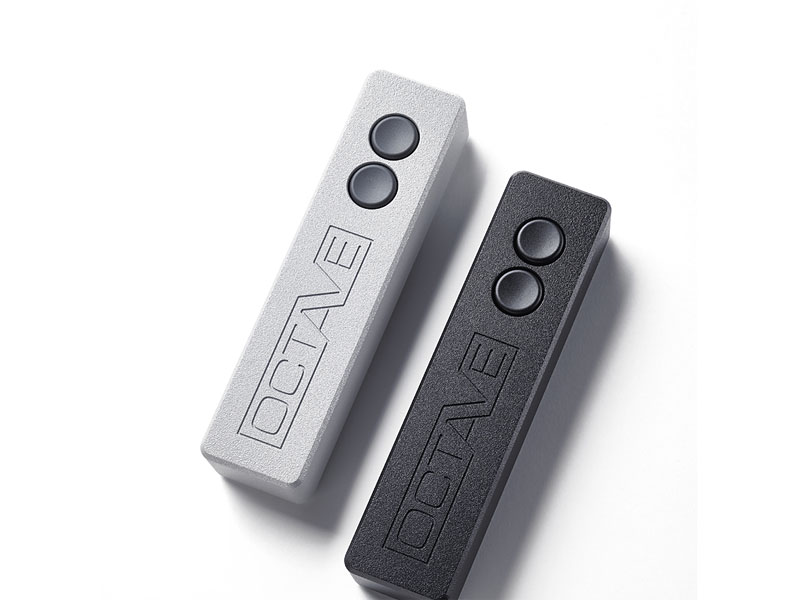
Soon after I slid the package over to my work area (desk) and looked inside, I realized that this octogenarian had his work cut out for him. Inside the shipping container was a box containing the V 70 SE along with a smaller box for the power tubes (four KT88s) and another even smaller box for the remote control. In addition to the wire-bound, comprehensive, illustrated instruction manual, a pair of white cotton gloves is included for handling the tubes, as well as a cleaning cloth. You’ll also find an Allen key for use in removing the protective cover and a small, flat-bladed screwdriver for use in bias adjustment. With help, I placed the V 70 SE on a small dolly and set about installing the four power tubes (the driver tubes were already installed). It is a solid, brushed-aluminum-cased component measuring 17 3/4” w x 16 3/8” deep x 5 7/8” high and weighing 48.7 lbs. It should come as no surprise that the V 70 SE uses custom designed and in-house built transformers since it comes from a company with a history of transformer design and manufacturing. The V 70 SE uses tubes with modern semiconductor circuits, and it is capable of delivering up to 70Wpc into 4 ohms. Besides being a class-AB, push-pull, pentode design, it shares chassis build and styling with the other integrated amplifiers in the Octave lineup, including the V 70 Class A and V 80 SE, which offer up to 60 and 150Wpc into 4 ohms, respectively. These components also share soft-start power management, Octave's Eco Mode protection system, the setting of bias with display, monitor/record outputs, and home-theater bypass. Options include installation of a moving-coil or moving-magnet phono board (not both, each $950) and a power supply capacitance upgrade (Black Box or Super Black Box, see sidebar). Available finishes of the sturdy aluminum chassis and remote are matte black or matte silver. The front of the V 70 SE is adorned with only two substantial, solid-acting knobs: one for input selection and one to control volume. Nestled between these knobs is a glass-paneled display containing banks of small LEDs for identifying the position of the seven-step input selector, tube-bias settings and power modes. On the left of the display and arranged vertically are five of these LEDs, corresponding to the four RCA and one XLR inputs. Centered and arranged horizontally at the top of the display are four more LEDs, one for each of the power tubes. These are activated when the selector knob is turned to position six and give a visual indication of bias adjustments. On the right of the display are four additional LEDs identifying power status, protection activation, soft-start and bypass of the power-amp section. On the unit’s rear, in addition to the solid speaker connectors, are outputs, including one set of RCA record outs and one set of RCA regulated preamplifier outs. Also on the rear panel, you’ll find a Black Box connector and a three-position Ecomode switch. Ecomode, when engaged, reduces the power consumption of the amplifier to about 25W (from 140W at idle) when no signal is present. It does so by turning off the output stage of the amplifier, thereby conserving energy, reducing heat, and extending the life of the output tubes and associated electronics. The IEC socket and integrated fuse holder, located on the right rear of the unit, let the listener use his favorite power cord. Conveniently placed on the front left side of the V 70 SE is a rocker-style on/off switch that operates with a reassuring “thunk.” Due to its Soft-Start feature, the V 70 SE turns on in stages, thus protecting tubes and other critical parts from current surges. The hefty metal remote control, limited to finely stepped volume adjustments only, is a pleasure to use, with a smoothness bordering on sensual. For those who like to tube roll, Octave has made bias adjustment as easy as turning a screwdriver, so other pin-compatible output tubes, such as KT120s, 6550s and EL34s can be used. The driver tubes (factory installed) consist of a single ECC83/12AX7 and a pair of ECC81s, ECC82s, E81CCs or 12AT7s. The dolly helped in positioning the V 70 SE next to my equipment rack so I could adjust the bias for the power tubes and make the connections for my source components and speakers. Adjusting the bias on the four KT88 output tubes took only a few minutes. With the V 70 SE warmed up, bias adjustment amounted to turning the input-selection switch to position six, observing the four vertical arrays of three bias LEDs in the center of the display, and inserting and turning the screwdriver in the hole beneath each of the arrays one way or the other until the correct color is displayed (green is normal). Clockwise turns increase bias, and counterclockwise decreases bias. Normally, when an Octave amplifier is new from the factory, the bias levels for the output tubes are preset and require no user adjustment. The unit I reviewed was a show/review demo unit, so adjusting the bias was necessary. The unit I was sent for review came with the optional MM phono board installed, so my initial listening was done with the turntable plugged directly into the dedicated phono inputs. My DAC was plugged into the XLR inputs. Using the pots on the front of the unit, bias on the supplied KT88 tubes can be set either high (34mA) or low (28mA). After listening at both settings, I ultimately chose to leave it at the high position (as recommended by Octave). I found that the higher bias setting produced sharper, more clearly defined images, greater sparkle to the highs, more energy in the lower mids and bass, a slight increase in soundstage boundaries, longer decay on struck or plucked notes, and an overall more involving listening experience. After setting bias I was ready to do some listening, so I mounted my daily go-to cartridge, the Audio-Technica VM750xSH, with an output of 3.7mV, on the tonearm, dialed it in and put an LP on the platter.
rom the first notes of Bernstein’s stunning performance of Stravinsky’s game-changing Le Sacre Du Printemps [Columbia Masterworks MS 6010], I knew something special was happening here. My copy, a six-eye first pressing, put to tape in 1958 in a Brooklyn hotel’s ballroom no less, enabled the V 70 SE to unambiguously display all of the sonic characteristics I seek in music playback. The first thing I noticed was that my listening room seemed to have grown in size; the large orchestra seemed to occupy a space in front of me whose boundaries were not defined by the speakers, with the soundstage broad and deep, extending well beyond the front wall. The immediate effect was to make me acutely aware of the acoustics of the recording venue and less conscious of my room. Another impressive aspect I heard was the sense of see-through transparency. For example, the trumpets, trombones, horns, tympani and bass drum all took on a presence that, on occasion, could sound shockingly realistic. Similarly, the subtle, soft, undercurrent voices of the various woodwind instruments could be heard with little to no effort. Couple that with startling dynamics when the recording allowed it, and you have all the ingredients for an enjoyable and stimulating listen.
After the cacophonous finale and tympani strike ending side one of Le Sacre Du Printemps, and with a big grin on my face, I flipped the record over and was again stunned by the quality of the recording as reproduced by the V 70 SE. Satisfied I’d just heard sound as good, if not better, than anything I’d heard before in my room, I sleeved the Stravinsky and reached for a more relaxed musical program. That choice was my 1959 Shaded Dog pressing of The French Touch, featuring Charles Munch and the Boston Symphony [RCA LSC-2292]. Again, this record highlighted the qualities of the Octave integrated and left me totally satisfied. It featured room-filling soundstaging and a faithfulness in the presentation that teased me into believing I was listening to a live orchestra stuffed into the confines of my smallish listening room. Curious to hear what the V 70 SE would do with the phono signal carried to it from the Octave Phono EQ.2 phono stage ($2150) I reviewed, I made the necessary connections, adjusted the EQ.2 for an MM cartridge and cued up the Stravinsky once again. I had been quite impressed with the onboard phono stage in the V 70 SE, admiring its ability to transform the music, of whatever genre, into an involving listening experience. I kept saying to myself I could easily live with this setup. That being said, what I heard after switching the input to the EQ.2 was an overall audible improvement. Detail retrieval was improved, and the music was presented with palpable texture and heft. There was also a noticeable gain in the sense of “rightness.” For example, playback of the second side of the Stravinsky LP suspended disbelief -- I was present in that ballroom for the performance. There was significantly more air around the instruments, with an accompanying increase in depth and separation. The struck antique cymbals, heard in the background roughly a third of the way through side one, had a more identifiable tonal character. And, most surprisingly, the brass instrument glissandi toward the end of the side were much more tangible. For a change of pace, sound wise, I occasionally swapped out the Audio-Technica cartridge for my Denon DL-103R moving coil and found it equally engaging. If you are a cartridge swapper, especially one using both MC and MM varieties, the choice is clear: go with Octave’s outboard phono stage. Sticking with symphonic music but going back several centuries, I reached for volume three of Christopher Hogwood and the Academy of Ancient Music’s respected interpretations of the Mozart symphonies [L'Oiseau-Lyre D169D3]. I recently became obsessed with these symphonies and have finally acquired all seven of Hogwood’s LP boxed sets as well as Pinnock’s English Concert performances in a CD boxed set. It is the music I listen to the most these days, as I find it refreshing and as comforting as slipping into a well-worn pair of slippers. I remain in awe of the fact that several of the symphonies were composed before Mozart was a teenager. Hogwood’s recordings are intimate and represent the modest, original-instrument orchestral forces with sound that’s immediate, dynamic, timbrally sharp and unforgiving. As symphony after symphony unfolded before me, the V 70 SE never failed to involve me in the music, be it the soft, quiet minuets, spirited allegros, or the loud, boisterous climaxes. I found myself putting aside thoughts of the music’s sound to concentrate on its substance, which was overwhelmingly rewarding. Before leaving the comfort of Mozart’s symphonies, I wanted to hear the music performed with a larger orchestra, so I reached for Erich Leinsdorf’s sprightly recordings with the Philharmonic Symphony Orchestra of London on Westminster [WMS-1025-6 ]. This set, the first integral cycle of the symphonies, was recorded in the mid-to-late 1950s, with the early symphonies recorded in true stereo, the later ones in monaural (electronically re-channeled to stereo for this edition). As I expected, the Octave V 70 SE did not disappoint. It was a joy to sit back, relax and let the music transport me back to the Days of Enlightenment when noblemen wore wigs and waistcoats. A recently acquired set of the complete Mozart symphonies, on CD, by Trevor Pinnock and the English Concert [Archiv Produktion 471 666-2] offered me the opportunity to evaluate how the V 70 SE handled digital sources and get another take on the music. After placing the first CD in my Sony transport’s tray and pushing play, I was greeted with the most enjoyable, immersive musical sound I have yet heard from CDs. The members of the English Concert were spread out in front of me, behind the plane of the speakers, sounding sinewy and determined as befit their gut strings and natural horn timbres. The boundaries of the small ensemble were easily detected, as its placement in the hall was revealed by the ability of the Octave’s ambiance retrieval. Pinnock’s Mozart, as heard through the Octave V 70 SE, came to life and opened a door into Mozart’s genius. I was similarly impressed with a CD set of the Haydn symphonies as led by Adam Fischer conducting the Austro-Hungarian Haydn Orchestra [Brilliant Classics 99925]. These recordings, made between 1987 and 2001, capture the vitality and brilliance of the composer in sound that rivals modern audiophile titles. I credit the Octave for bringing these modest yet vital works to life. For Haydn on vinyl I turned to a record gifted to me, Haydn 2032 No. 10 Les Heures Du Jour [Alpha Classics Alpha 687]. The sound of the pair of 180-gram LPs from this exquisite French production once again brought into focus the qualities of the Octave V 70 SE in lessening the barriers between listener and performance. From the first pianissimo entry, I felt present in the Gustav-Mahler Hall of Italy’s Euregio Kulturzentrum Toblach arts venue. Giovanni Antonini’s IL Giardino Armonico orchestra was right there, set back and centered between the speakers. The recording, brought to life by the Octave integrated, allowed each section and soloist to shine within a believable acoustical space. The unique timbre of the period instruments was revealingly illuminated. Orchestral tuttis were dramatic and forceful, unambiguously conveying the unique qualities imbued in these early symphonies by their twenty-nine year old composer. Turning to music not usually heard in concert halls, I cued up a recently acquired first US pressing of the Pretender’s self-titled 1980 debut [Sire SRK 6083]. As I settled back in my seat for a listen, I sensed I was witnessing a personality change in my speakers. This music, as rowdy and eye- and ear-opening as Stravinsky’s Le Sacre Du Printemps was seventy years earlier, leapt from the speakers in a squall of noise and attitude -- a far cry from the polite, ordered, predictable music of a young Mozart. This was just what I needed to judge the performance of the Octave integrated on loud, unsubtle music. Again, as I expected and my ears confirmed, there was nothing untoward about the sound. On “Precious,” Chrissie Hynde’s voice slapped me in the face, figuratively, as the group carried on their unforgiving beat. As I increased the volume, I was happy to observe the Octave, with nary a hiccup or misstep, gave no signs of stress as these new-wave artists wailed away on the vinyl. Toward the end of my listening sessions, I and a friend paid a visit to local record store We Got the Beats where, I found a near-mint copy of the two-LP set of music from the TV series Stranger Things [Sony Legacy 88985480901]. Back home, the four sides transported me, in exquisite sound, back to the 1980s, when my skin showed fewer wrinkles. From the visceral, in-your-face sound of the Scorpion’s “Rock You Like A Hurricane” to the dulcet lament of Cyndi Lauper’s “Time After Time,” I was never less than deeply involved in the music. I thank the Octave V 70 SE for making this transformation a reality. In the time I had the Octave V 70 SE, it was powered up for at least six hours every day. During that time, it didn’t hiccup, belch, or lose tube bias. It always remained exceptionally quiet and never got too warm to the touch. I never doubted its reliability and eagerly looked forward to my listening sessions. Sound-wise, there was nothing not to like. All the appropriate boxes in the audiophile lexicon were checked. I was finally able to put aside thoughts of the equipment used to bring the music to life. Instead, I could devote my attention to the music itself. Powering my EgglestonWorks Emma EVO speakers (6-ohm load, 88dB sensitivity), it never ran out of steam and, if pushed, would drive them to disco levels. It also cared not what genre of music I played -- it handled all of them with poise and musicality. I did have a few functional nits to pick with the V 70 SE, however. I wish there was an easier way to see the level indicator of the volume knob. Sitting in my listening seat, I could not tell what position the volume was in. I ended up putting a piece of black tape on it so I could tell where it was positioned. Similarly, it was difficult to tell which of the inputs was selected because the lettering on the input selector knob was so small. I would also have liked to have seen input selection available on the remote control, since I have gotten lazy over time and would just as soon not have to get off my butt to change sources. Lastly, changing the driver tubes appeared to be a challenging task, since only the very top of those tubes were visible, protruding from the chassis, leaving no easy way to grasp them for their removal and/or replacement.
y time with the Octave V 70 SE helped me question or dismiss some long-held myths regarding tubes -- the “floppy,” limited bass and soft, anemic treble. I didn’t hear these at all. What I heard was focused, extended, tuneful bass with palpable impact. Treble was similarly extended, precise, textural and airy. But the myth of tube power providing a magical midrange was thoroughly upheld. What I heard was a musical presentation was very much akin to what I recall when I was in the presence of the real thing. To quote Andreas Hofmann, owner and chief developer of Octave Audio: “Music is not just about precise highs, mids and bass, but about the fun, the emotion in the music that makes the soul vibrate. We claim that Octave amplifiers transport these vibrations and that listening to music with Octave is an unforgettable experience.” I wholeheartedly concur regarding the V 70 SE. The faultless and compelling sound I heard with this integrated amp could not be unheard. It consistently gave me more insight into the musicians and music that I love. Consequently, I tended to play records in full and avoided sampling of streamed content. If the Octave V 70 SE integrated amplifier (even better
with the Black Box upgrade) fits within your budget, I urge you to give it a listen. If
you hear what I heard, you’ll soon be reaching for your checkbook.
|
|||||||||||||||||||