|
|
About The Audio Beat
Editor
Marc
Mickelson
A professional
background in teaching, technical writing and information technology lost out to
audiophilia more than twenty-five years ago when Marc became part of the audio press.
Since then, he has written hundreds of equipment and music reviews and edited the work of
dozens of writers. He began work on The Audio Beat in mid-2009, and the site
launched on October 1. Marc lives northwest of Phoenix, Arizona, in a large listening room
with a Southwest-style house attached.
Senior
Contributors
Dennis
Davis
Dennis gave up an unpromising career as a pianist in
college when he avoided the practice room and began spending far too much time in the
library reading back issues of High Fidelity and lusting after AR 3a speakers. By
the late 1960s, he had saved enough money for a used pair of the speakers and never looked
back. In the early 1990s, he founded the San Francisco Bay Area Audiophile Society, and
later that decade he began writing jazz reviews for Secrets of Home Theater and High
Fidelity. He has been a regular writer for Hi-Fi+ since Issue 31. He has
been an avid record collector for decades.
Roy
Gregory
Roy has served his hi-fi time from every angle --
as customer, retailer, manufacturer's and distributor's representative, reviewer and
editor. He was the founder and loudest (some say too loud) voice of Hi-Fi+, to
which he continues to contribute. He brings his wealth of experience and unique
perspective to The Audio Beat, producing far more than just straightforward
equipment reviews.
Contributors
Mark
Blackmore
Retired
after 31 years as a band director, Mark joined the faculty of the University of
Missouri-St. Louis. He and his wife Lisa teach trumpet at UMSL and perform with the St.
Louis Wind Symphony and Compton Height Concert Band. A big fan of SET amps and
high-efficiency speakers, Mark spends his free time listening to a watt or two with his
two cats, Chet and Ella.
John
Crossett
E arly
attempts at learning the viola ended in dismal failure, but music and its reproduction
continued to play important roles in John’s life. He has always considered his audio
system a means to an end -- listening to his favorite music -- not an end in itself. For
ten years, John wrote music and equipment reviews for Soundstage. He lives in
northern Vermont with his stereo and ever-growing collection of jazz, rock, classical, and
blues LPs, CDs and SACDs.
Guy Lemcoe
Guy is a retired social-services worker who was
exposed at an early age to music on his parents' all-tube Fisher system. By the end of
high school, he was headed toward a career as a professional musician -- anyone remember
"The Cheater" by Bob Kuban & the In Men, circa 1966? College and then
graduate school beckoned, and Guy put down his trumpet and began writing about music and
audio gear. He was a contributing editor at Stereophile from 1989 to 1996 and has
had articles published in Dirty Linen, Opus and Spectrum. Music comes first
for Guy, with equipment running a close second. He prefers vinyl and spends much of his
spare time listening to records. A resident of Delray Beach, Florida, with his partner,
Barbara, and their cockatiel, Chigger, Guy looks forward to sharing his thoughts on music
and equipment.
Ross Mantle
Ross is a Professor of
Neurosurgery in the Great White North. He has formal training in piano, violin and jazz
saxophone, the scars from which have never fully healed. He became fascinated with audio
gear as a student, learned to assemble a credible audio system, and worked part-time for
several years as an editor, audio reviewer and opinion columnist. During the format debate
of the early 2000s, he predicted the demise of spinning discs in favor of non-physical
digital media. Ross took a hiatus from audio reporting over the last ten years, but he
wishes now that he had continued to write about audio back then, when he still knew
everything. He has steadfastly resisted vinyl, believing that digital will eventually
catch up. He favors mid-power tube equipment, fine digital, and plasma tweeters.
Jim Saxon
In 1979, Jim's first hi-fi system cost $2500 and elicited
a typical critique from an audiophile friend: "Isn't it amazing how bad twenty-five
hundred bucks can sound?" Since then Jim has devoted his life to "getting it
right." After spending 33 years and hundreds of thousands of dollars in the pursuit,
he all but abandoned hope of owning a system that he considered "right" -- so he
became one of the most widely published online audio scribes instead. In addition to The
Audio Beat, Jim has been published by Soundstage, Enjoy the Music
and 6 Moons.
Kevin
Whitehead
The longtime jazz critic for National Public Radio’s
Fresh Air, Kevin is the author of Why Jazz? A Concise Guide (2010), New
Dutch Swing (1998, about improvised music in Amsterdam), and Instant Composers Pool
Orchestra: You Have to See It (2011, with photographer Ton Mijs). His next book, due
in 2019, is a comprehensive study of fiction films that tell jazz stories. The many
periodicals he’s written for include the Chicago Sun-Times, Village Voice,
Down Beat, Point of Departure, and the Dutch daily de Volkskrant. His
essays have appeared in such collections as Jazz: The First Century, The Cartoon
Music Book, and Traveling the Spaceways: Sun Ra, the Astro-Black and Other Solar
Myths. Kevin has taught at the University of Kansas, Towson State University, and
Goucher College. He lives near Baltimore.

What
We Do and Why We Do It
When
I began talking with Paul Bolin about creating an online audio site, I settled very
quickly on the idea that I would only build something I would value and want to
read myself. Thus, while The Audio Beat will cover the entire spectrum of audio
products, we will have no quota for the types of products we review or their cost. You
will read about what interests us most -- great speakers, electronics and source
components, along with the music we listen to and cherish. Paul put it well in one of his
e-mail messages to me.
I
think it would be counterproductive to try to be everything to every audio enthusiast. We
have both focused on and had wide experience with the best of the best that the high-end
world has to offer. There is a place for reviews of relatively inexpensive gear, but only
where it offers extraordinary performance for the money. Our focus should be on the things
we do best.
As much as is humanly possible, the publication should endeavor to speak with one
editorial voice. I mean this not in terms of an unbendable orthodoxy or the squelching of
dissenting opinions, but in terms of what is important to us and what is most desirable in
the performance of components and systems.
Like
so many of the best audio components, The Audio Beat is a direct reflection of
the people who created it. We wouldn't have it any other way.
Marc
Mickelson
October 2009
A
Note on Navigating The Audio Beat
The
Audio Beat makes extensive use of a JavaScript utility called Slimbox 2. This
overlays graphic images onto the current page without changing the page's native layout.
We use Slimbox 2 for photos, which we can display in groups, or galleries, without having
to place them all on the page. We also offer its use to advertisers.
Be
sure to click on thumbnails you see below photos. These signal that extra pictures or a
gallery exists. Once the Slimbox 2 window appears, you can scroll through all pictures by
hovering on the window and clicking the PREV and NEXT tabs. Any captions appear at the
bottom of the window.
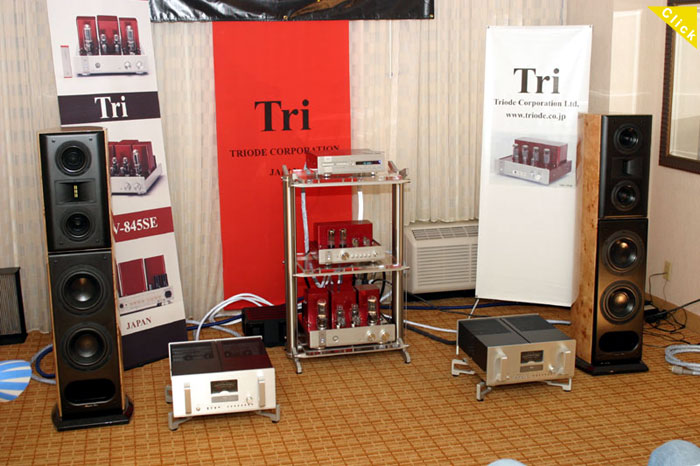
Older
articles on the site will have a "Click" symbol in one of the upper corners. In
this case, click on picture itself.
|
|

|